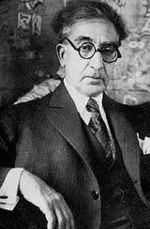
Konstantinos P. Kavafis
Born in 1863 and died in 1933, on his birthday (April 29), in Alexandria, Egypt. He spent most of his life in this city, except for six childhood years in England, over two teenage years in Constantinople, and a few later travels, the most significant but brief ones being to Athens. His last trip was related to a health issue that eventually led to his death. Coming from a family of once-prominent merchants that had fallen on hard times, Cavafy initially sought a career in journalism and politics but eventually abandoned these pursuits. At the age of 29, he was hired and served for 30 years (until 1922) as a salaried employee "in a government office under the Ministry of Public Works of Egypt," as he described his livelihood in a brief autobiographical note. Outwardly, Cavafy's life seemed solitary, "orderly and mundane," without "spectacular or terrible" events. Some peculiarities of his life are noteworthy, such as never installing electricity in his home, instead using his legendary candles, and leaving behind a modest but not insignificant estate, along with a related memorandum on stock market activities. Most importantly, he left a poetic archive meticulously organized, ready to welcome scholars of his work. His sexual orientation is well-known: he was suspected (and some were or are certain) of being homosexual, while K. Th. Dimaras wrote about his "solitary satisfaction." Another rumor suggests that Alekos Sengopoulos, an admirer of his poetry and primary heir, was Cavafy's son. What is striking about his life is his absolute dedication to his work. This dedication is also reflected in his unique publishing approach: although he published regularly, Cavafy never released his own book. Instead, he printed his poems on single sheets, which he then compiled into makeshift "collections" (some chronological, others thematic) and distributed them to friends and acquaintances or sent them to those interested in his work. The 154 poems, his official poetic corpus, were first printed in 1935 in Alexandria in a luxurious edition overseen by his heirs. The work was philologically restored in the well-known two-volume edition by "Ikaros," edited by G.P. Savvidis in 1963. Cavafy became known to the Greek readership through the historic article by Gr. Xenopoulos in the magazine "Panathenaia" (1903), while he was introduced to the English-speaking audience by the English novelist and friend, E. M. Forster, in 1919. Since then, his work has achieved nationwide and worldwide recognition, having been translated into many modern languages. A tangible acknowledgment of his influence is that his great contemporary, Bertolt Brecht, wrote and published a poem in 1953 that clearly draws from Cavafy's "Trojans."
(Source: "K.P. Cavafy: Official, Hidden, and Incomplete," "Hermes," 1995)


 Greek Fiction Books
 Poetry Books
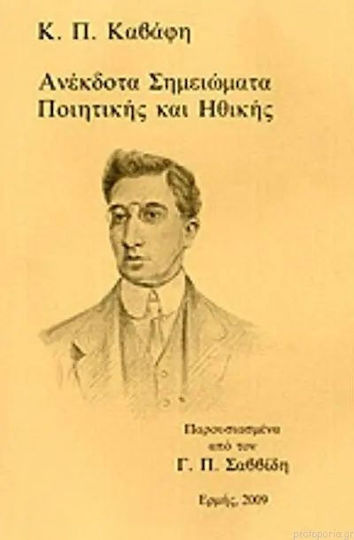 Greek Fiction Books
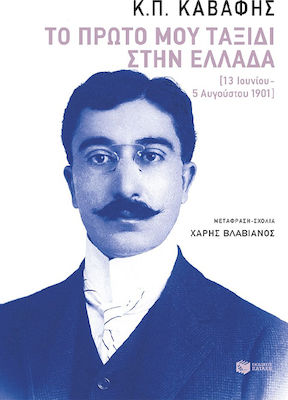 Greek Fiction Books
 Greek Fiction Books