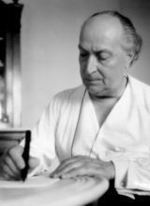
Agelos Sikelianos
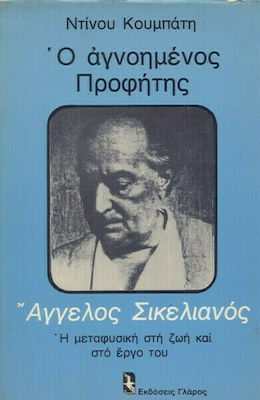
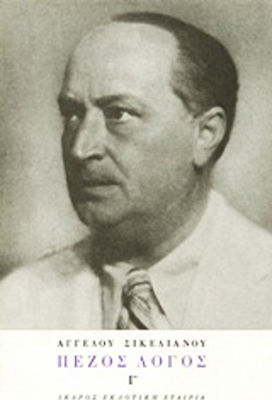
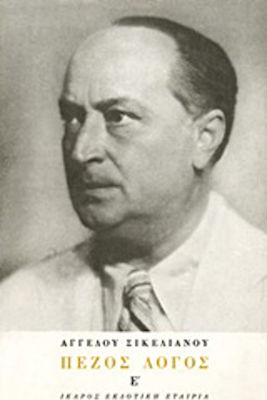
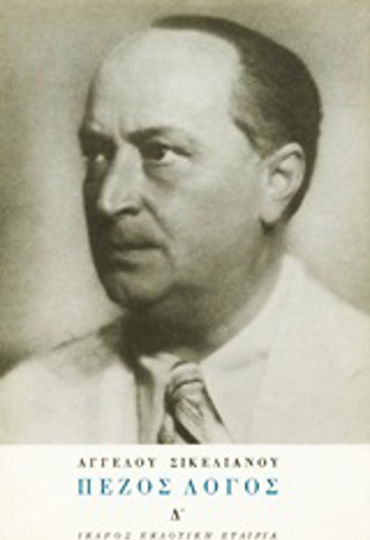
Angelos Sikelianos (1884-1951). Angelos Sikelianos was born in Lefkada, the son of Ioannis Sikelianos and Charikleia née Stefanisi. He learned his first letters from his father. In Lefkada, he completed elementary school, Greek school, and high school. During his adolescence, he began his first engagement with poetry. In 1901, he left for Athens, where he enrolled in the Law School. In Athens, he came into contact with the New Stage of Konstantinos Christomanos, where he worked as an actor. In 1902, he published his first poems in literary magazines of the time, including Dionysos and Panathinaia, and a year later collaborated with Noumas. In 1904, he began his journey towards a more ambitious poetic writing through the pages of Akritas, and a year later he left for Libya, where he wrote "Alafroiskiotos," which was published in 1909 to great success. In 1906, he returned to Lefkada. It was then that he began living with Eva Palmer, whom he had met in 1905 at his sister Penelope's house and married in 1907 in America. After the wedding, the couple settled in Athens and became acquainted with literary circles. The following year, their son Glafkos was born. In 1910, Sikelianos participated in the founding of the Educational Association and the following year published the Delphic Hymn and left with his wife for Paris, where they attended a performance of ancient drama by the Duncan couple. That same year, his father passed away. In early 1912, he visited Paris again. That same year, he enlisted in the Balkan Wars. After returning to Athens in 1913, he continued to publish poems in Noumas until November 1914, when he met Nikos Kazantzakis, with whom he formed a deep friendship, and departed with him for Mount Athos and a tour around Greece. Together with Kazantzakis, they sided with Venizelos in 1915 during the Greek politician's break with the Palace. In 1917, his sister Penelope passed away. That summer, he visited Prastova in Mani with Kazantzakis, and in 1919 Olympia and Epidaurus. In 1920, he stayed with his wife in Sykia, Corinthia, and in 1921 he left for a pilgrimage to the Holy Land. He returned to Sykia and that same year turned towards a comprehensive conception of the Delphic Idea, influenced by the Asia Minor Campaign, the impacts of World War I, and the outbreak of the Russian Revolution. In the summer of 1922, he left for Agoriani, where he studied the practical application of the Delphic Idea and learned about the Asia Minor Catastrophe. The following year, he gave twenty lectures at the Law School on the expression of the idea of world peace and brotherhood throughout the ages. In 1924, he settled with his wife in Delphi, where they continued preparations for the realization of the Delphic Idea. In Delphi, his mother, who died a year later, was buried. Sikelianos had earlier invited intellectuals from around the world to the future International Center of Delphi. In June, he recited the Ode to Valaoritis during the celebration of the hundredth anniversary of the poet's birth in Lefkada. In May 1927, the Delphic Festivals were inaugurated, achieving great success in Greece and resonating abroad. Two years later, an article was published in the Ionian Anthology proposing Sikelianos for the Nobel Prize, and the Academy of Athens honored the Sikelianos couple for reviving the Delphic Festivals. In 1930, the second Delphic Festivals took place with the presence of political figures and were as successful as the first. Over the next two years, the Delphic Union was founded with state support, Sikelianos was invited to Paris where he met Paul Goncourt and Paul Valéry, and upon returning to Greece, he published an educational manifesto for the Delphic Union and the book "Delphic Idea: A Prelude." In 1933, two performances of Sikelianos' tragedy "The Dithyramb of the Rose" were staged under his direction with the collaboration of Eva. The following year, there were some state efforts to establish the Delphic Center, which were not completed. In Paris, Louis Roussel promoted Sikelianos' name with a series of articles in the magazine Libre. In 1936, Sikelianos issued a manifesto for the organization of the Delphic Festivals and the Delphic spiritual center. In 1938, he met Anna Karamanis, whom he married in Eleusis in 1940. That same year, he wrote "Sibylla." With his second wife, he settled in Athens and traveled to Aegina. In 1943, he recited the poem "Sound the Trumpets" during the funeral of Kostis Palamas. In 1944, he began to experience health problems. In 1946, he was nominated twice by the Society of Greek Writers for the Nobel Prize, the second time jointly with Kazantzakis, and together with the latter, they welcomed Paul Éluard in Athens. In 1947, he was elected president of the Society of Greek Writers and was nominated again—this time by a group of European writers—for the Nobel Prize. In 1950, he suffered a stroke and died in 1951. Sikelianos' literary work served his grand vision of the poet's role as a proponent and missionary of a religious ideology, which, by incorporating the tradition of the world's journey through the ages, envisions the reconnection of man with the archetypal Myth of unified psychosomatic existence. In this theoretical contemplation, Sikelianos subordinated his expressive means. He adopted a pre- and anti-logical expression in both his poetry and tragedies and assimilated various spiritual influences. His writings contain elements that refer to the movements of romanticism, aestheticism, symbolism, as well as to ancient Greek Orphic and pre-Socratic philosophers. For more biographical details on Angelos Sikelianos, see Anton John P., "Sikelianos Angelos," World Biographical Dictionary 9a. Athens, Ekdotiki Athinon, 1988, and Responsibility Notebooks 11. Athens, 1980. (Source: Archive of Greek Writers, EKEBI).
 Greek Fiction Books