Georg Büchner
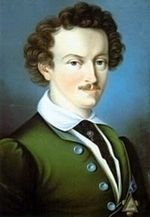
Georg Büchner was born on October 17, 1813, in Goddelau, Germany. As the son of a military doctor, he studied medicine at the University of Strasbourg. However, from a very young age, he wrote poems and short stories. Influenced by the Paris uprising of 1830, he founded the "Society for Human Rights" (1834) and illegally published the revolutionary pamphlet "The Hessian Courier," which shed light on the struggle of the German bourgeoisie against the absolutism of feudalism. The pamphlet was immediately confiscated by the authorities, and to avoid arrest, he fled to Strasbourg (1835) and later to Zurich, where he was accepted at the university as a doctoral candidate (1836). He died of typhoid fever on February 19, 1837. Büchner's plays were far ahead of their time, and he is rightly considered today a major precursor of theatrical expressionism and a prominent figure in German literature.
His main works include:
- "The Hessian Courier" ("Der Hessische Landbote") 1834, Pamphlet
- "Danton's Death" ("Dantons Tod") 1835, Play
- "Lenz" ("Lenz") 1835, Novella
- "Leonce and Lena" ("Leonce und Lena") 1836, Play
- "Woyzeck" ("Woyzeck") 1836-37, Play.