Giorgos Seferis
Giorgos Seferis (real name Giorgos Seferiadis, 1900-1971) was born on February 29 or March 13, 1900, in Smyrna, Asia Minor, and was the son of Stylianos and Despo Seferiadis (née Tenekidis). Stylianos Seferiadis was a distinguished academic and professor of International Law at the Faculty of Law of the University of Athens, a writer (with a prolific scientific body of work), and a diplomat. He passed on his love for literature to his three children, Giorgos, Angelos, and Ioanna (later the wife of Konstantinos Tsatsos), all of whom pursued literary interests. In 1914, with the onset of World War I, the Seferiadis family moved to Athens, where Seferis completed high school in 1917. He then went to Paris to study law until 1924. However, as early as 1918, his love for poetry emerged, and he began writing verses. During his studies abroad, he had the opportunity to engage directly with the literary movements of the time. The Asia Minor Catastrophe also found him in Paris, profoundly affecting him and leaving a lasting impression on his memory. In 1926, Giorgos Seferis began his diplomatic career, being appointed as an attaché at the Ministry of Foreign Affairs. Until his retirement in 1962, he served as vice-consul and consul in London (1931-1934), in Korçë, Albania (1936-1938), and as a press advisor at the Ministry of Foreign Affairs. After the declaration of World War II, he followed the Greek government to Crete, Egypt, South Africa, and southern Italy, and after the liberation, he returned to Athens, where he stayed until 1948. He was then appointed as an advisor at the Greek embassies in Ankara and London, later becoming an ambassador in Lebanon, Syria, Jordan, and Iraq, and finally in London (1957-1962). In 1963, he was awarded the Nobel Prize in Literature. After retiring from his diplomatic career, he devoted himself entirely to his literary work until his death in 1971. His funeral, amidst the dictatorship and following his 1969 Declaration, became a demonstration against the regime of the colonels.
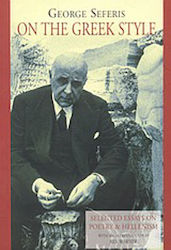
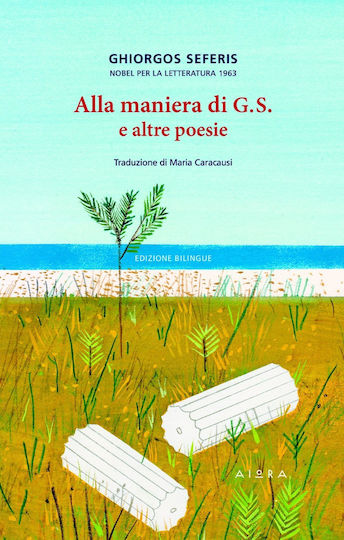
Giorgos Seferis's first work was the collection "Strophe," published in 1931. This collection sparked various reactions as it brought a breath of renewal to Greek poetry. It was followed by "Sterna" (1932) and "Mythistorema" (1935). A year later, he wrote "Gymnopaedia," and in 1938, responding to Konstantinos Tsatsos's essay, he published "Dialogue on Poetry." In 1940, "Notebook of Exercises 1928-1937" and "Logbook I" were published, containing significant poems such as "Mr. Stratis Thalassinos" and "The King of Asine," as well as a collection of his previously published works titled "Poems." In 1944, "Logbook II" was published, written in Egypt and South Africa, where Seferis followed the exiled Greek government. "Logbook II" was followed by the three-part "Kichli" (1947), considered by many as one of Giorgos Seferis's most important works, and the collection "..Cyprus, where it was ordained for me," which was released in 1955 during the Cypriot Struggle and later renamed "Logbook III." In 1950, the collection "Poems 1924-1946" was published, which is an enriched edition of his first collection of works ("Poems I"). The last collection printed by George Seferis during his lifetime, published 11 years after "Deck Diary III," is "Three Secret Poems" (1966). The poet's swan song is "Exercise Book II," published in 1976, edited by G.P. Savvidis, who has also edited most of the poet's works. Besides his poetic work, Seferis has made significant translations, such as T.S. Eliot's "The Waste Land" (1936) and "Murder in the Cathedral" (1963), "Song of Songs" (1965), "The Revelation of John" (1966), "Copies" (1965, containing works by European and American poets such as Ezra Pound, Andre Gide, Paul Eluard, Pierre-Jean Jouve), and "Transcriptions" (1980, containing texts from ancient literature). Special mention should be made of Seferis's essays, in which he developed his views on contemporary language and literature issues. He wrote about Kalvos, Dante, Palamas, Sikelianos, Makriyannis, Cavafy, Eliot. These were published under the title "Essays" (1944, a two-volume edition in 1974 by Ikaros, edited by G.P. Savvidis; the third volume was also published by Ikaros in 1992, edited by Dimitris Daskalopoulos).
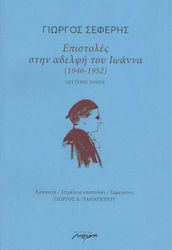
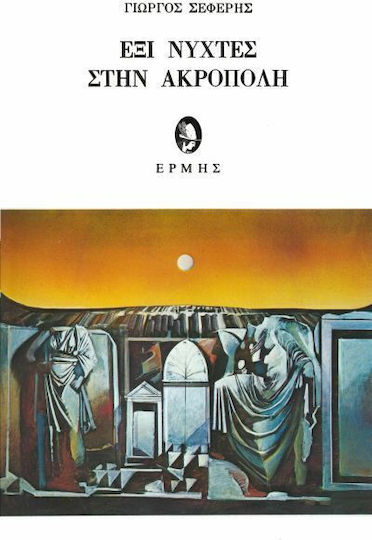
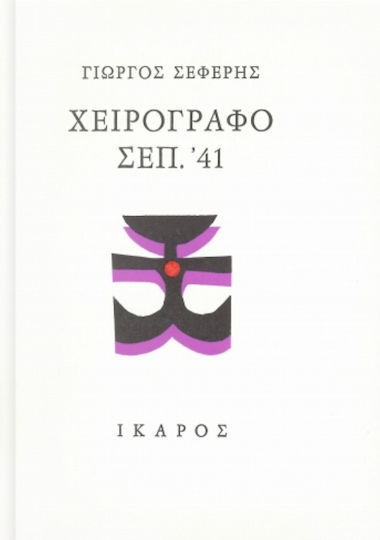
Additionally, there is the poet's personal diary, with the general title "Days," which began to be published in 1975, four years after his death (Volumes A-G, 1925-1960; in 2001, the last volume of the diary, "Days H," covering the last decade of his life, was published by Ikaros, edited by Katerina Krikou-Davis), from which one can glean extremely interesting information about both the poet and his work, as well as political and diplomatic developments in Greece. After his death, the first two volumes of the "Political Diary" were also published (Ikaros editions, 1979 and 1985 respectively), edited by Alexandros Xydis. In addition to the above, Seferis also wrote "September '41 Manuscript" and the novel "Six Nights on the Acropolis," which, although begun between 1926-1928, was published in 1974. The last section of Seferis's writings consists of his correspondences, the first of which was published with George Theotokas (1930-1966). These are followed (in succession) by correspondences with Adamantios Diamantis (Cypriot painter, 1953-1971), Andreas Karandonis (1931-1960), his wife Maro Seferi (Volume I, 1936-1940), Zissimos Lorentzatos (1948-1968), and Edmund Keeley (1951-1971).
 Greek Fiction Books
 Greek Fiction Books