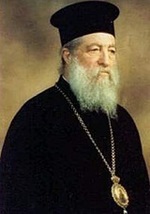
Dionysios L. PSarianos Mitropolitis Servion kai Kozanis
Nikolaos Psarianos, known in the secular world as Nikolaos Psarianos, was born in Pitrofos, Andros, in 1912. He was the first of eight children of Priest Leonidas Psarianos and Presbytera Marigo. From a young age, he demonstrated not only various skills but also an artistic inclination, as everything he crafted with his hands stood out. He completed primary school in Pitrofos and attended high school in the town of Andros, walking three hours daily with his classmates.
In 1927, his uncles, the chief musicians Nikos and Kostas Lavdas, included him in the Athens Mandolinata they had founded in Plaka, where he studied music for two years. However, his father needed his help and called him back to the village, where he worked in agriculture for two years while also chanting in the church of Saint Panteleimon. As he himself said, "I started to become a teacher and priest in my village, studied music at my father's wish, almost became a captain, and finally followed my innate inclination and became a Clergyman."
In 1934, after being discharged from the navy where he served, he was ordained Deacon in Poros with his father's blessing, then became a Priest, and later received the office of Archimandrite. He graduated from the Theological School of Athens in 1942. In 1952, he was ordained Bishop of Rogon and in 1957 was elected Metropolitan of Servia and Kozani. He served the church from this position until his death in 1997, while simultaneously creating a rich body of written work, both in verse and prose.
In between, he served as Protosyncellus in the Holy Metropolis of Tripoli and later in the Archdiocese of Athens, where his rare administrative, priestly, and liturgical skills were highlighted. Dionysios wrote with almost equal ease sonnets, hymns, music, poetry, sermons, short stories, studies, and essays. Critics had already recognized his genuine talent and his persistent care for well-crafted phrases and literary expression.
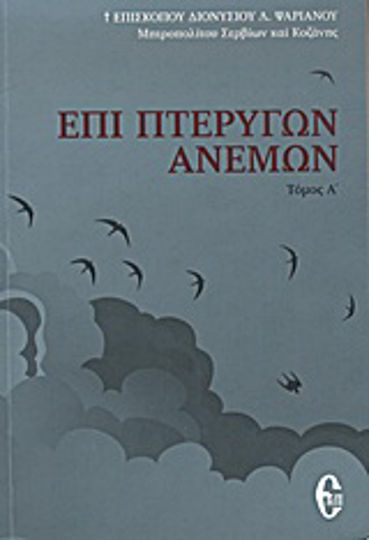 Religion & Metaphysics Books
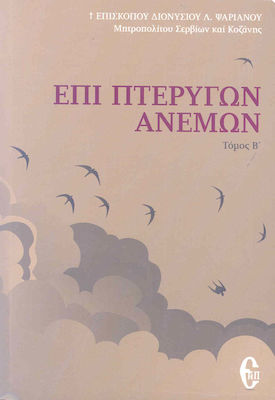 Religion & Metaphysics Books