Ioannis o Damaskinos
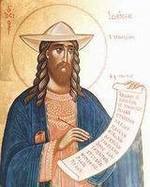
Saint John of Damascus (c. 676 - December 5, 749) was a Syrian monk and priest. He was born in Damascus, which is the origin of his epithet, and belonged to a prominent family. His father, Sergius, was the governor of Damascus, which was then under Saracen control.
Encouraged by the Patriarch of Jerusalem, John was ordained as a priest and settled in the Monastery of Saint Sabbas, near Jerusalem. He spent his entire life there studying and writing, primarily focusing on musical works.
John was an iconophile and fervently opposed the iconoclastic emperors Leo III the Isaurian and Constantine V Copronymus. Through his letters, he urged the people of Constantinople to honor icons. It is said that Leo ordered a forgery of John's handwriting to send a fake letter to the Caliph, suggesting that John offered Damascus to the Byzantines. The Caliph was convinced and ordered John's right hand to be cut off, which was miraculously healed. Following this event, he composed the First Ode of the Canon of the First Tone, "Your victorious right hand, in a manner fitting God, has been glorified in strength."
Due to his eloquence, he was also called "Chrysorrhoas" (Golden-Stream), and for his extensive musical work, he was named "Master of Music." He was canonized as a saint, and the Orthodox Church commemorates him on December 4, while the Catholic Church does so on May 6.