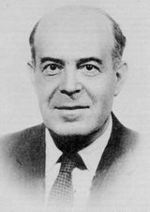
Petros Glezos
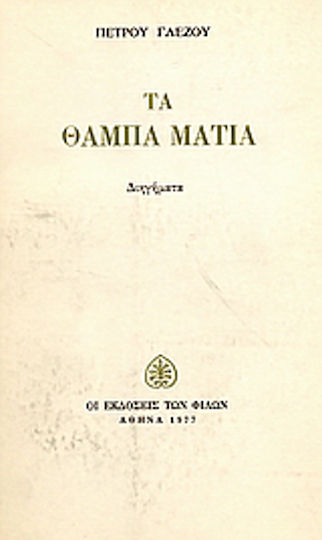
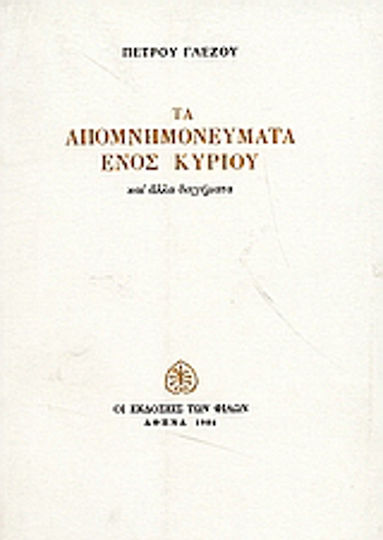
Petros Glezos (1902-1996). Petros Glezos was born in Apeiranthos, Naxos, the son of landowner Dimitris Glezos, who passed away when the author was nine years old, and Kalliopi Zevgoli. He had seven siblings. He spent his childhood in the town of Naxos and, after his father's death, in Athens, where he settled with his mother and siblings. He graduated from the Secondary Education Teachers' College of Dimitris Glinos and then studied at the Law School of the University of Athens. During his studies, he worked as a copyist in a law office, a proofreader for the newspaper Kathimerini by Georgios Vlachos and the magazine Chronika by Kostas Kotzias, and as an employee of the Ministry of National Economy. After graduating, he worked as a lawyer and as an employee of the Ministry of Agriculture and the Agricultural Bank. He contributed as a columnist to many magazines and newspapers in Athens and the provinces, mainly with Nea Estia, To Vima, and Eleftheria. He was honored with the Academy of Athens Award (1977 for the short story collection "The Dim Eyes") and the First State Short Story Award (1986 for the short story collection "The Memoirs of a Gentleman"). From 1980 and for several years, he served as the president of the National Society of Greek Writers. His works have been translated into English, French, Spanish, and Danish. He passed away in Athens in 1996, the same year as his wife and lifelong companion, the poet Dialechti Zevgoli. He made his first literary appearance around 1920 with the publication of the poem "April Night" in the magazine Oikogeneiakos Astir. During the same period, he gave a lecture titled "Greek Light," for which he was awarded by the Touring Club, and in 1936 he published the short story "Family" in the magazine Nea Estia under the pseudonym Petros Valmas, which he maintained until 1949. Despite his long life and wealth of experiences, Petros Glezos, who lived through the historical events that marked Greece, from the Asia Minor Catastrophe to the dictatorship of '67 and the post-dictatorship period, rarely and only implicitly refers to the historical and social context of his characters. What mainly concerns him is conveying their existential anxiety, as shaped by external events, to which they silently submit, perhaps with some bitterness but without resistance. His writing is characterized by low-key sensitivity, an emphasis on the psychological portrayal of characters, and nostalgia for a vanishing past. Generally, although most of Petros Glezos's work is set in the post-war period of Greek prose, it continues the tradition of Greek psychological ethnography that began in the previous century with leading figures like Georgios Vizyinos and Alexandros Papadiamantis and continued with authors such as Pavlos Nirvanas and Ioannis Kondylakis. For more biographical details on Petros Glezos, see Manolis Gialourakis, "Glezos Petros," Great Encyclopedia of Modern Greek Literature 5. Athens, Haris Patsis, n.d., Takis Mendrakos, "Petros Glezos," Interwar Prose; From the First to the Second World War (1914-1939) Vol. III, pp. 160-174. Athens, Sokolis, 1992 and n.d., "Glezos Petros," World Biographical Dictionary 3. Athens, Ekdotiki Athinon, 1985. (Source: Archive of Greek Writers, EKEBI).


 Greek Fiction Books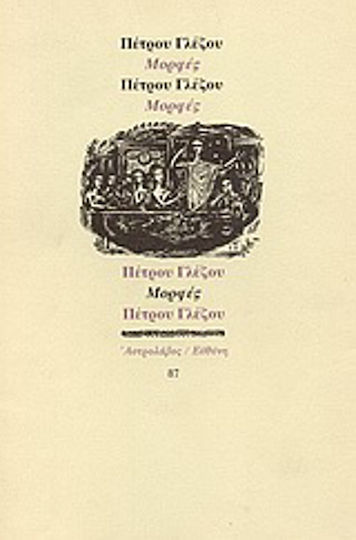

 Greek Fiction Books