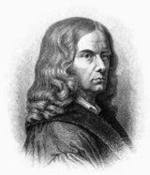
Adelbert Von Chamisso
Louis-Charles-Adélaïde Chamissot de Boncourt, later known as Adelbert von Chamisso, was born on January 30, 1781, at the Château de Boncourt in Champagne. His father was an officer in the French army. In 1790, following the confiscation of their property and pursued by the French Revolution, Chamisso's family fled France, and his now impoverished parents sought refuge in Liège. From there, they moved through The Hague, Düsseldorf, and Bayreuth, eventually settling in Berlin.
In 1801, Chamisso enlisted in the Prussian army with the rank of second lieutenant. By 1803, having fully adopted the German language, he published, in collaboration with close friends, the "Berlin Musenalmanach," where he also released his first works. This publication ceased at the end of 1805. A year earlier, Chamisso founded a romantic society in Berlin named "Nordstembund."
His early poetry, such as the song cycle "Frauenliebe und Frauenleben" ("A Woman's Love and Life"), which was set to music by Robert Schumann, expresses simple emotions in the characteristic manner of German Romantic poetry of his time. In contrast, his ballads and narrative poems often feature more paradoxical or mournful themes.
Disillusioned with life in the Prussian army, he resigned in 1806 and, the following year, traveled to France and Switzerland, where he settled on the estates of Madame de Staël and dedicated himself to the study of natural sciences. By 1812, having returned to Berlin, he began studying medicine and botany, which continued until 1815.
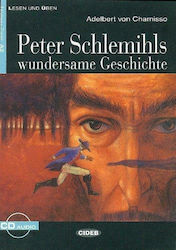
In 1814, his masterpiece, the novella "Peter Schlemihl's Remarkable Story," was published, which he had written the previous year during the "War of Liberation," one of the Napoleonic Wars. The work was translated into many languages and brought him worldwide fame.
In 1821, he released his book "Bemerkungen und Ansichten auf einer Entdeckungsreisen," describing his three-year journey with the Russian exploratory expedition Romanzoff (1815-1818), considered a classic of its kind. After returning from this journey, he was appointed director of the Berlin Botanical Garden.
As a physiological scientist, Chamisso was associated with the discovery of the alternation of generations in certain mollusks, and as a philologist, he was distinguished for his study of Australasian languages.
He died on August 21, 1838, in Berlin.