Fidel Castro
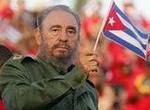
Fidel Castro
Fidel (or Fidel) Castro, full name Fidel Alejandro Castro Ruz, was born in Birán, Cuba, on August 13, 1926. Fidel Castro studied law at the University of Havana and practiced as a lawyer for a period of time. Even as a student, he became involved in revolutionary movements against Batista's dictatorship. During the Santiago uprising (July 26, 1953), he was one of the leaders in the attack on military camps, but he was arrested and sentenced to 15 years in prison. In 1955, he was granted amnesty and fled to the United States, where he attempted to inspire Cuban exiles to join the revolution. However, the American government opposed him, leading Castro to escape to Mexico. From there, with a small group of men, he landed in Cuba (December 2, 1956) and took to the mountains. The revolutionary movement gained significant momentum, and the rebels, after many successes, captured the capital, Havana, on January 1, 1959. Batista fled Cuba, and Fidel Castro assumed the position of Prime Minister (1959), a role he held until 1976. In 1965, he became the General Secretary of the Communist Party of Cuba, and in 1976, he consolidated the positions of Head of State and Commander-in-Chief of the Armed Forces. In 1991, he was re-elected as General Secretary of the party, and in 1993, 1998, and 2003, the Council of Representatives renewed his presidential term for five years. He emerged as a leading figure of the Third World and strengthened his country's ties with both African and Asian nations. In 1975, he sent troops to Angola to support the People's Movement for the Liberation of Angola, and in 1978, to Ethiopia to counter Somalia's invasion. These actions, along with the assistance he provided to the Sandinistas in Nicaragua in 1979, further strained relations with the United States. In 1991, the collapse of socialist regimes and the dissolution of the Soviet Union marked the beginning of significant economic challenges for Cuba, forcing Castro to make some moves towards liberalizing the Cuban economy. He was honored with the International Lenin Peace Prize (1961) and the Joliot-Curie Gold Medal for Peace in 1972. He authored political works, the most recent of which include "October Revolution" and "Cuban Revolution" (1978), and "Fidel" (1987). The Cuban leader, Fidel Castro, underwent intestinal surgery on July 31, 2006, and temporarily transferred power to his brother, Raúl Castro. On February 19, 2008, after half a century at the helm of Cuba, Castro announced his official resignation. He passed away in Havana on November 25, 2016, at the age of 90.
0