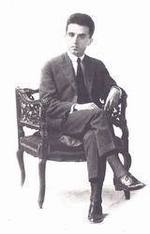
Kostas G. Karyotakis
Born on October 30, 1896, in Tripoli, his father was a civil engineer, which meant that during his childhood, he frequently had to change his place of residence. He lived in Argostoli, Lefkada, Larissa, Kalamata, Athens, and even Chania. From 1912, he began publishing poems in various children's magazines. After obtaining his degree from the Law School of Athens, he was appointed as an employee at the Prefecture of Thessaloniki. His free spirit could not tolerate the bureaucracy of the state machinery, which he criticized whenever possible (notably in the prose work "Katharsis"). As a result, he was frequently transferred, often persecuted by his superiors. During these transfers, he experienced the boredom and misery of the provinces, which left a mark on him. In February 1919, he published his first collection, "The Pain of Men and Things," which received indifferent or dismissive reviews. In the same year, together with his friend Agis Leventis (under the pseudonyms Mimis Chlapatsas and Nikos Tsapatsoulias, respectively), he published the satirical magazine "The Gamba," which, despite its success, only ran for six issues because the police banned its publication. In 1921, he released his second collection, "Nepenthe." Around that time, he became associated with the poet M. Polydouri, a colleague at the Prefecture of Attica. Many claim that their relationship was romantic. In 1924, he traveled abroad to Italy and Germany. In December 1927, his last collection, "Elegies and Satires," was published. In February 1928, Karyotakis was transferred to Patras and in June to Preveza. From there, he sent desperate letters to relatives and friends, describing the misery that prevailed in that city (notably in the poem "Preveza"). On July 21, he ended his life.



 Greek Fiction Books
 Poetry Books
 Greek Fiction Books