Maria Polydouri
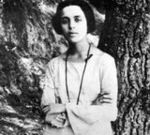
Maria Polydouri
Maria Polydouri (1902-1930). Maria Polydouri was born in Kalamata, the daughter of high school principal Eugenios Polydouris and Kyriaki, née Markatou. She spent her childhood in Gytheio, Filiatra, and Kalamata, where she completed high school and in 1916 published the prose poem "A Mother's Pain" in the magazine "Family Star." In the same year, she compiled poems in the collection "Daisies," which she did not publish. In 1918, she was appointed to the Prefecture of Messinia. In 1920, both her parents died, first her father and forty days later her mother. In 1922, she was transferred to the Prefecture of Attica. She had already enrolled in the Law School. It was then that she met Kostas Karyotakis, whom she fell passionately in love with, and published verses in the magazines "Esperos" (of Syros), "Hellenic Review," "Pandora," "Children's Joy," and "Eva." In 1924, she met Aristotelis Georgiou. That same year, she abandoned her studies and enrolled in the Drama School of the National Theatre and the Kounalakis School. In 1926, she participated in a performance of Nikontemi's play "The Rag" and went to Paris, where she attended courses at the Pigier dressmaking school. In Paris, she contracted tuberculosis and was hospitalized at the Charite hospital. She returned to Athens in 1928 and was admitted to the Sotiria sanatorium and later to the Christomanou clinic, where she died at the age of twenty-eight. During her hospitalization, she managed to publish the poetry collections "Trills that Fade" (1928) and "Echo in Chaos" (1929). Maria Polydouri is placed among the generation of neo-romantic or decadent Greek poets of the interwar period, alongside names such as Tellos Agras, Kostas Karyotakis, Napoleon Lapathiotis, and Kostas Ouranis. In her early poetic work (before her trip to Paris), strong neo-romantic tendencies, influences from the symbolism movement, and a personal style are evident, while after her illness, her return to Athens, and Karyotakis's suicide, the melodramatic element recedes, and her writing becomes more refined. Her writing is intensely emotionally charged, with themes centered around love and death. She also wrote a novella titled "Novel" and some poetic translations included in her Complete Works volume of 1982, edited by Takis Mendrakos. For more biographical details on Maria Polydouri, see Tellos Agras, "Polydouri Maria," Great Greek Encyclopedia 20. Athens, Pyrros, 1932; Alex. Ziras, "Polydouri Maria," World Biographical Dictionary 8. Athens, Ekdotiki Athinon, 1988; and Sofia Mavroeidi-Papadaki, "Polydouri Maria," Great Encyclopedia of Modern Greek Literature 11. Athens, Haris Patsis, n.d. (Source: Archive of Greek Writers, EKEVI).
 Greek Fiction Books
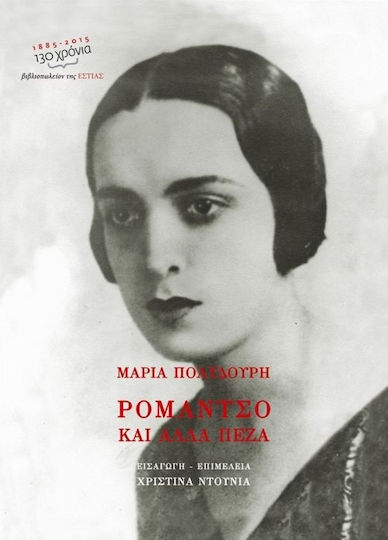
Ρομάντσο και Άλλα Πεζά, Volume b'
Maria Polydouri, 2014 , Estia Bookstore
from11,67 € at 5 stores0