Kaisar Emmanouil

Kaisar Emmanouil
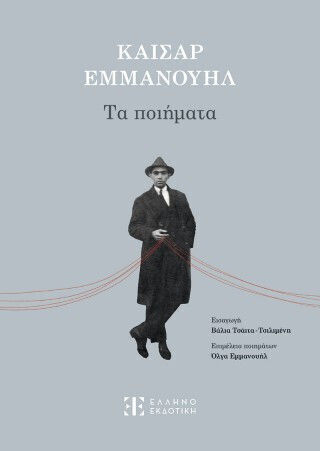
Caesar Emmanuel (1902-1970). Caesar Emmanuel was born in Athens, though his family hailed from Patras. He was a second cousin of the poet Ioannis Papadiamantopoulos (Jean Moreas). He spent his school and teenage years in Poros, Dragatsi, and finally Piraeus, where he completed high school. He enrolled in the Faculty of Philosophy at the University of Athens but interrupted his studies in the final year to fulfill his military service. After completing his service, he was compelled to work, which delayed his graduation until 1938. He opened a tutoring school in Neo Faliro and, in 1928, was appointed as a translator (he spoke English, French, and Italian) at the insurance company Athenian, where he remained for about ten years. After graduating from the University, he taught in private educational institutions for approximately twenty-five years. From 1937 to 1940, he collaborated with the Romanian newspaper Le moment as a French-language literary correspondent. After 1953, he worked in education in Cyprus, Alexandria, Cairo, and Ismailia. Upon returning to Greece, he dedicated himself to literary translations and adaptations until the end of his life. He died of diabetes at the municipal hospital of Athens. Caesar Emmanuel made his literary debut in 1924 and collaborated with literary magazines such as Mousa, Kritiki kai Techni, Neoi Vomoi, Hellenic Review, Nea Estia, Logos, Kyklos, Rythmos, Bouquet, Oikogeneia, Anagennisis, Nea Epitheorisis, The Third Eye, Macedonian Letters, and others. His first poetry collection was titled The Discordant Flute and was published in 1929. Three more collections followed, while the main body of his work consists of poetic, prose, theatrical, and other translations and adaptations. Emmanuel's poetry is situated within the context of Greek interwar poetry, particularly among the younger poets of the 1920s generation (including Alexandros Baras, Yiannis Skarimpas, Orestis Laskos, Kostas Ouranis, Nikos Kavvadias, and others who partly followed in the footsteps of Karyotakis, Lapathiotis, Filyras, Agras, etc.). Kostas Stergiopoulos identifies two phases in his work: the earlier phase dominated by elements of neo-romanticism and cosmopolitanism (in the footsteps of Kostas Ouranis) and the second phase, which marked his transition to the symbolist movement and pure poetry of Baudelaire, Valery, Mallarme, as well as Apostolos Melachrinos. For more biographical details on Caesar Emmanuel, see Manolis Gialourakis, "Emmanuel Caesar," Great Encyclopedia of Modern Greek Literature 6. Athens, Haris Patsis, n.d., Kostas Stergiopoulos (ed.), "Caesar Emmanuel," Greek Poetry; Anthology - Grammar; The Renewed Tradition, pp. 436-439. Athens, Sokolis, 1980, Kostas Stergiopoulos, "Caesar Emmanuel and the Publication of His Poems," Caesar Emmanuel, Poems; edited by Kostas Stergiopoulos, pp. 13-20. Athens, Prospero, 1980, and h.s., "Emmanuel Caesar," World Biographical Dictionary 3. Athens, Ekdotiki Athinon, 1985. (Source: Archive of Greek Authors, EKEBI).

0