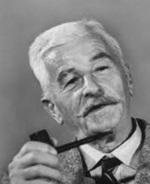
William Faulkner
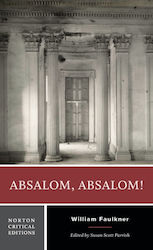
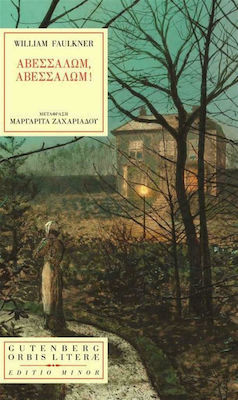
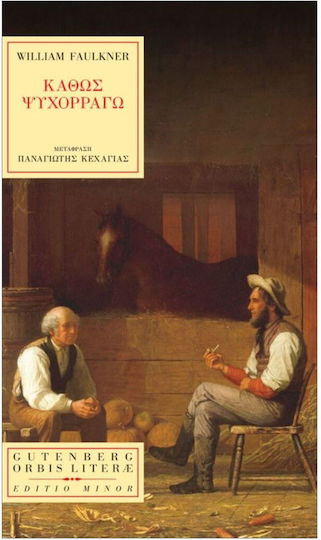
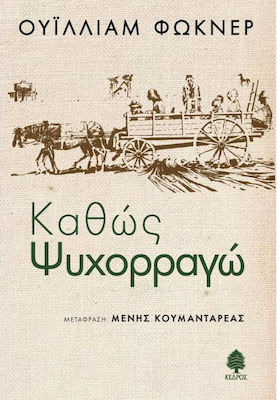
William Faulkner was born as William Cuthbert Falkner in New Albany, near Oxford, Mississippi, in 1897. Although his great-grandfather was a colonel and a prominent figure of the American South, Faulkner was not accepted into the military when America entered World War I. Shortly thereafter, he managed to enlist in the Canadian and later the British Royal Air Force, and after the war, he attended the University of Mississippi for a time. He dropped out of his studies—he was, after all, a mediocre student—and took on various odd jobs, including working at a bookstore in New York and a small newspaper in New Orleans. In 1924, his friend Phil Stone arranged for the publication of his poetry collection "The Marble Faun" in 1,000 copies. In New Orleans, he became acquainted with a circle of writers that included Sherwood Anderson, who encouraged him to turn to prose, leading to the creation of his first novel, "Soldiers' Pay," published by Boni and Liveright in 1926. In 1929, he got married and took a night shift job at a local power plant. During that time, over six weeks in the summer, from midnight to four in the morning, he wrote "As I Lay Dying," which was published the following year (1930). This was followed by "Sanctuary" (1931) and some screenplays for Hollywood (including Howard Hawks' "Today We Live" in 1933, based on his own short story, and later adaptations of Raymond Chandler's "The Big Sleep," starring Humphrey Bogart and Lauren Bacall, as well as Hemingway's "To Have and Have Not"), as his book sales were insignificant. Despite being a recognized author, Faulkner led a troubled life, plagued by alcoholism and depression. In his world, despite the focus on the American South, the narrative takes on universal significance as a stance against human destiny and issues such as racial discrimination. Among his most important works, often characterized by experimental writing influenced by the European avant-garde, are the novels "Mosquitos" (1927), "Sartoris" (originally titled "Flags in the Dust," 1929), "The Sound and the Fury" (1929), "Light in August" (1932), "Absalom, Absalom!" (1936), "The Wild Palms" (1939), "The Hamlet" (the first part of the Snopes trilogy, 1940), "Requiem for a Nun" (1951), "The Town" (1957), and "The Mansion" (1959—the second and third parts of the Snopes trilogy), "The Reivers" (1961), as well as more than 80 collections of short stories. In 1949, he was awarded the Nobel Prize in Literature, in 1955 the National Book Award and the Pulitzer Prize for Fiction (for the novel "A Fable"), in 1962 the Gold Medal for Fiction from the American Academy of Arts and Letters, and posthumously, a second Pulitzer Prize (for the novel "The Reivers"). In 1957, he was accepted by the University of Virginia as a writer-in-residence. In 1961, he donated his personal archive to the same university to establish the William Faulkner Foundation. He died of cardiac arrest in Byhalia, Virginia, in 1962, and was buried in the cemetery of Oxford, Mississippi, a state he never left during his lifetime.
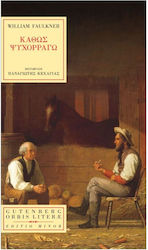
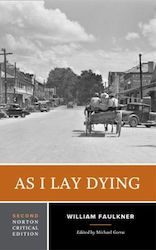
 Greek Fiction Books
 Greek Fiction Books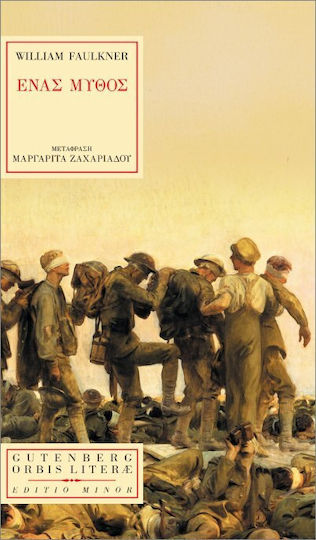
 Greek Fiction Books
 Greek Fiction Books
 Greek Fiction Books