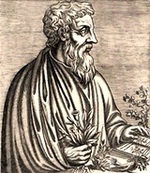
Dioskouridis
He was born in Anazarbus, Cilicia, and lived in the 1st century AD. He served as a physician in the Roman army and is considered the most important pharmacologist of Antiquity. He was educated in Tarsus, which was the most renowned botanical-pharmacological center of the time, and traveled extensively to gather experiences from various regions. Through personal observation and consulting earlier literature, he wrote his principal work "De Materia Medica" in Greek, spanning five volumes.
Another of his books on medicines was regarded by Galen (129-199 AD) as the most comprehensive and well-founded book of the era. A third book titled "On Simple Medicines," which was previously considered pseudonymous, is now attributed by most researchers to Dioscorides. Other pharmacological books are disputed, as they seem to mimic the style of the great pharmacologist, but are considered to be of a later date.
Although Dioscorides aimed to remain within the realm of naturalism, he did not avoid mentioning some "magical" substances in his book, which appear to have been widespread at the time. Dioscorides' pharmacological books were translated into many European and Eastern languages and served as fundamental manuals until the Renaissance. With the emergence of organic chemistry in the 19th century, Dioscorides' botanical-based prescriptions declined, though they continue to be used in modified forms in folk practice and homeopathy.