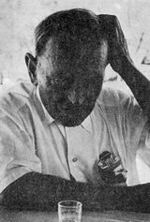
Giannis Skarimpas
Giannis Skarimpas (1893-1984). The autobiographical notes of Skarimpas contradict each other regarding the details of his birthplace and birth year. Based on research conducted after the author's death, Giannis Skarimpas was born in 1893 in Aigio, Achaia, to Euthymios Skarimpas and Andromachi née Liakou Skartsila. His father was of humble origins, while his mother came from a noble lineage and was educated. He had a younger sister, Kalliopi (born in 1915), who was involved in poetry. In 1906, he graduated from the mutual teaching Primary School of Itea. Encouraged by his teacher due to his high performance, young Giannis enrolled in the Greek School of Aigio, where he completed his general studies (graduating in 1908) and simultaneously obtained a diploma from the city's middle forestry school. In 1912, he worked as the head of accounting at the Patras branch of the German company "Singer." At the end of the following year, he enlisted to fight in the Second Balkan War, where he attained the rank of corporal. After the outbreak of World War I, Skarimpas's battalion was transferred to the Macedonian front. There, he distinguished himself and was awarded a medal for a neck wound. In October 1916, he was granted leave and returned to Agia Euthymia. During World War I, he was relieved of his military duties after passing a customs guard examination. In 1919, he was stationed at the Chalkida customs office and enrolled in the Faculty of Philosophy at the University of Athens. That same year, he married Eleni Kefaliniti (with whom he had five children) and, after his marriage, was transferred to the newly established customs office in Eretria, where he stayed until 1922. After the Asia Minor Catastrophe, he returned to Chalkida, where he remained until the end of his life. During his stay in Eretria, Skarimpas completed his first nine short stories, but his conscious engagement with literature dates back to his return to Chalkida. At that time, he studied modern Greek poetry and folk songs, as well as works by Edgar Allan Poe, Knut Hamsun, Miguel de Cervantes, Fyodor Dostoevsky, Henrik Ibsen, and Oscar Wilde, which influenced his work. His first official appearance in literature occurred in 1929 with the publication of his short story "At the Stone Columns in the Harbor" and his award in the nationwide short story competition of Kostas Bastias's magazine "Greek Letters" for his work "Captain Sourmelis the Stouraitis," which was enthusiastically received by the judging panel (Bastias, Fotis Kontoglou, Kostas Kartheos, and Leon Koukoulas). In 1930, he published his first collection of short stories titled "Sorrows in Gryponisi." A turning point in his career was his next work, published in 1932, titled "Uncle Lamb," with evident influences from French surrealism. This was followed by "Mariampas," which was hailed by critics as a masterpiece, and in 1938, his first poetry collection titled "Oulaloum" was printed. During the Greco-Italian War, he published articles in the Chalkida newspaper "Evripos" and developed an interest in Greek shadow theater. During the German occupation, he was at risk of dying from starvation, and in 1942, a highly publicized trial took place against him initiated by Argyris Valsamas for slander, as the latter claimed that Skarimbas' play "Caesar's Wife" was a copy of Somerset Maugham's "The Painted Veil." He enlisted in the National Liberation Front (EAM), yet he was neither persecuted nor exiled, and in 1945, he published the short-lived newspaper "Liberty." His political activity was subdued both during the civil war and later under Papadopoulos' dictatorship. His writing and publishing activities continued until the last years of his life, encompassing poems, novels, short stories, plays, essays, and studies. He was honored by the Society of Euboean Studies (1964) and the Municipality of Chalkida (1978), as well as receiving the First State Prize for Prose for his book "Flight Forward." He passed away at his last residence on Komini Street 8 in Chalkida and was buried at public expense. Giannis Skarimbas is chronologically placed in the generation of the 1930s, yet he remains a solitary figure and was ignored for many years by the literary science in Greece. His prose is characterized by elevating language to a dominant element through its systematic dislocation (a technique reminiscent of surrealism) and placing the plot at the level of a pretext, while his poetic work moves in parallel and complementary to his pioneering writing. Skarimbas was one of the introducers of the absurd in modern Greek literature and theater (many scholars consider him the first Greek playwright of the absurd). The information was drawn from entries by Kostiou Katerina, "Skarimbas Giannis," World Biographical Dictionary 9a. Athens, Ekdotiki Athinon, 1988, Kostiou Katerina, "From the Workshop of Giannis Skarimbas: Surprises and Traps," Periplous 44, 3-6/1997, pp. 35-51, Papadimitrakopoulos Ilias Ch., "Giannis Skarimbas," Interwar Prose: From the First to the Second World War (1914-1939) H', pp. 8-31. Athens, Sokolis, 1993, Papastamos Giorgos, "Work-Biography Timeline of Giannis Skarimbas (1893-1984)," Diavazo 269, 4/9/1991, pp. 20-27, and Epta Imeres Kathimerini, "The Chalkida of Giannis Skarimbas," 6/4/1997. (Source: Archive of Greek Authors, EKEBI).

 Greek Fiction Books
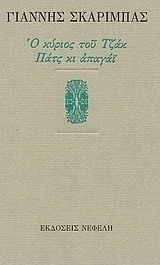 Greek Fiction Books
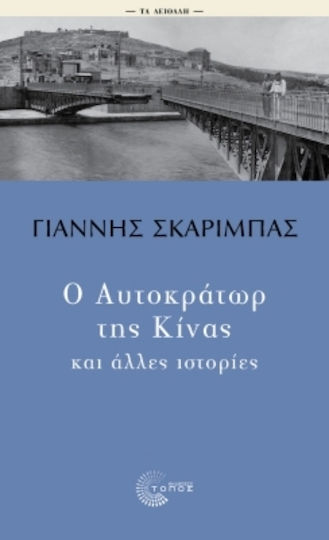 Greek Fiction Books
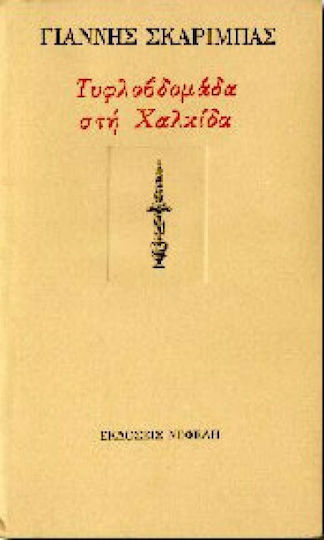 Greek Fiction Books