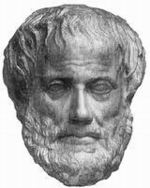
Aristotelis
Aristotle, one of the greatest Greek philosophers, researchers, and thinkers, was born in Stagira, Chalkidiki, to the physician Nicomachus and Phaestis in 385 BC. Following the oracle of Delphi's prophecy - "the god Pythia advised him to philosophize in Athens" - he studied philosophy under Plato in Athens and taught at the Academy (367 - 384 BC). In 348 BC, after Plato's death, he went with Xenocrates to Assos in Asia Minor, where he taught philosophy and scientific subjects to a wide audience. In 345 BC, possibly at the invitation of Theophrastus, he settled in Mytilene and remained there teaching until 342 BC, when Philip II entrusted him with the education of the then thirteen-year-old Alexander.
In 336 BC, after Philip's death, he returned to Athens, and in 335 BC, he founded the "Lyceum" between Lycabettus and Ilissos, also known as the "Peripatetic school" due to the many porticoes of the building. In 323 BC, after the death of Alexander the Great, he withdrew to Chalcis, his mother's homeland, where he died of a stomach ailment in 322 BC. Most of Aristotle's works have been lost. Those that have survived are categorized into logical, physical, biological, psychological, metaphysical, ethical, political, technological, and problem-related writings.