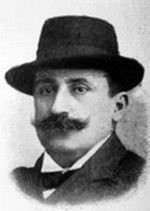
CHristos CHristovasilis
CHRISTOS CHRISTOVASILIS (1861-1937). Christos Christovasilis was born in Soulopoulo, Kalama, Epirus, the son of the wealthy landowner Anastasios Vasileiou. His grandfather was Christos Vasileiou (from whom the writer's pseudonym is derived), a lord of Soulopoulo in the 19th century. The exact date of his birth is not known, but scholars place it around 1860. He received his early education at the School of Xanthi and continued with the help of his uncle, Spyrakis Vasileiou, as a student at the Evangelical School of Smyrna. In 1875, he was arrested by the Turkish authorities during the Eastern Crisis and taken hostage to Constantinople. After three years of study at the Imperial Lyceum there, he escaped and fled to Corfu, from where he moved to Epirus, participated in a skirmish against the Turks in Agioi Saranta, was captured, and exiled to Trikala. There, he worked as a secretary for his uncle Spyrakis Vasileiou, the overseer of Christakis Zografos' estates. In 1882, he returned to his birthplace, but after participating in revolutionary movements again, he was sentenced to death. He escaped and returned to Thessaly. In Trikala, he welcomed the entry of the Greek army into Thessaly with the lengthy poem "To Our Brothers," an action that led to a brief imprisonment in Zitsa, where he went to marry Siana Papastavrou. From 1885, he settled in Athens. There, he made his official literary debut with the short story "My Best New Year," which won an award in the Acropolis competition of Gavriilidis. He worked for the same newspaper from 1889, publishing short stories and political articles (as a correspondent in Russia, Bulgaria, and elsewhere). In 1896, he remarried, this time to Alexandra Gioti from Karpenisi. In 1899, he began collaborating with the Hellenism Society of Nikolaos Kazazis, serving as director and later publishing treatises in the Society's magazine (of the same name) under the pseudonym Zeus Dodonaios. One of these treatises, titled "National Songs 1453-1821," led to a disagreement with Nikolaos Politis. He eventually left the Society in 1909 and moved to Smyrna, where his uncle Spyrakis was located. In 1913, he returned to Athens, celebrated the liberation of Ioannina with the poem "The Liberated Ioannina from the Acropolis," and left for his birthplace, where he published the newspaper "Eleftheria" and participated in political struggles concerning the Northern Epirus issue. For his actions, he was exiled to Naxos in 1917. It was during this time (1916-1919) that he wrote "Tales of the Little School." He was elected as a Member of Parliament for Ioannina in 1926 and 1935 with the People's Party, and from 1923 until his death, he directed the publication of the magazine "Epirotika Fylla." Shortly before his death, he visited Athens again, where he received an award for his literary work from the Ministry of Education and was honored with the Golden Cross of the Savior for his patriotic actions. The extent of Christovasilis' work (folkloric, historical, short story, prose, poetic, linguistic, dramatic, translational) is vast, with much of it found in newspapers and magazines of the time. His literary work is mainly ethnographic and folkloric, written in the demotic language, with a dominant presence of idyllic and nature-loving elements, as well as elements of deliberately "simple and naive" writing. Modern criticism focuses on the psychographic dimension of Christos Christovasilis's work and the grandeur of his descriptions of the provincial landscape. For more biographical details on Christos Christovasilis, see Agra Tellos, "Christos Christovasilis," Great Greek Encyclopedia 24. Athens, Pyrsos, 1934; Chrysogelou - Katsi Anna, "Christos Christovasilis," Our Older Prose: From Its Beginnings to the First World War H · 1880-1900, pp. 286-337. Athens, Sokolis, 1997; and h.s., "Christos Christovasilis," World Biographical Dictionary 9b. Athens, Ekdotiki Athinon, 1988.
(Source: Archive of Greek Authors, E.KE.VI.).
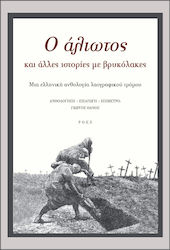
 Greek Fiction Books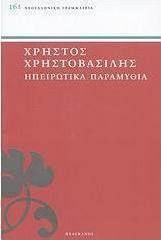
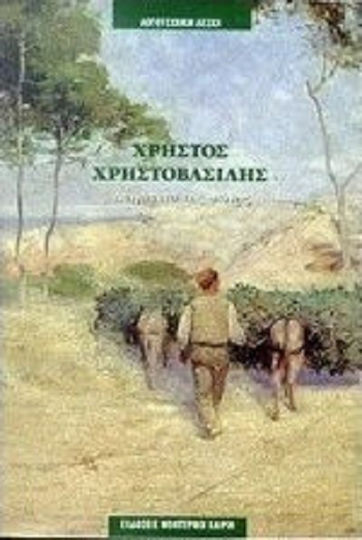 Greek Fiction Books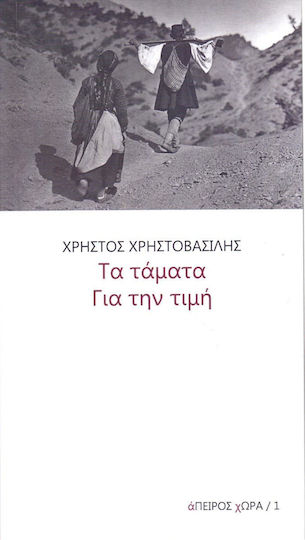
 Greek Fiction Books
 Greek Fiction Books