George Sand
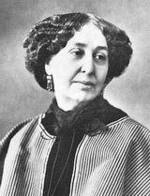
Amantine Lucile Aurore Dupin, Baroness Dudevant, known as George Sand, was born in Paris on July 1, 1804. After the death of her father, she was taken in by her grandmother, Madame Dupin. She spent her childhood in the countryside, in the Nohant region of Indre, a period filled with countless daydreams and endless evenings listening to rural tales, which would deeply influence her future work.
In 1822, she married Baron Dudevant and had two children from this marriage. However, she soon separated from her husband and, in 1831, left Nohant with her children for Paris. There, she led a bohemian lifestyle that scandalized the high society of the time, with her eccentric clothing—often appearing dressed "like a man," smoking a pipe or cigars—and her well-known romantic adventures with figures such as Jules Sandeau (who gave her the pseudonym Sand), Alfred de Musset, Pierre Leroux, and Chopin, with whom she lived for ten years starting in 1837.
The Baroness Dudevant became George Sand. Under this pseudonym, she published the novel "Indiana" in 1832, which was a great success. This was followed by romantic works such as "Valentine," "Lelia," and others that reflect the life of that era.
After 1864, George Sand became associated with well-known democrats and social utopians of the time (it should be remembered that during this period, Louis-Philippe was the king of France), including Barbès, Arago, and Lamennais. This association influenced her works, such as "Horace," published in 1841, and "Le Meunier d'Angibault," published in 1845, which reveal her social and humanitarian concerns.
In 1848, she wanted to participate in the Revolution and attempted to publish a newspaper to express her ideas. However, the uprising of the same year frightened her. She left Paris and took refuge in Nohant, where she became known as "the good lady of Nohant."
From this period come her works "La petite Fadette," "Les maîtres sonneurs," and other wonderful pastoral novels, as well as works like "Les beaux Messieurs de Bois-Doré," from 1858.
George Sand passed away in Nohant on June 8, 1876.