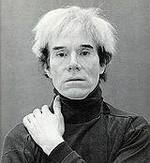
Andy Warhol
Andy Warhol was born in 1928 to immigrant parents from Eastern Europe. His childhood coincided with the Great Depression of the 1930s, which forced him to decode how the world worked from a young age in order to survive. The results of this knowledge can be recognized in his art, a product of such experiential study.
Warhol also invented his own image, describing himself as a "creature of fantasy," a clever "construct" that moved from discos to film clubs, fashion shows, galleries, and media events. Unfortunately, the intelligent cosmopolitanism, inherent misanthropy, and creative flirtation with frivolity of the cunning Warhol were transformed by the legions of social replicas that followed into millions of cheap poses of vanity, which at the very least provoke nausea.
Andy was a "fragile" and lonely child. His mother stood by him, caring for him during his difficult illnesses and protecting him from the teasing of his peers, as he did not participate in games and sports. As he grew up, he studied art at the Carnegie Institute of Technology and had no difficulty finding work as an illustrator for fashion magazines like "Glamour" and "Harper's Bazaar" after graduating in 1949. In the late 1940s, he realized his homosexual tendencies. It is no coincidence that his work from that period is characterized by an expression of sexual and artistic awakening. Later, he enlarged pieces from comics and other elements of pop culture from newspapers and magazine advertisements, transforming them into paintings like "Coca Cola" and "Telephone" (1960), and the "Campbell's Soup Cans" (1960-'62). During that period, he also adopted the technique of silkscreen printing directly onto canvas, using commercial stamps and other photographs as subjects.
He continued his frenetic activity at the famous "Factory" in central Manhattan, where he created large-scale paintings, sculptures, and films with his "followers." It was then that actress Valerie Solanas, an "unstable psychological personality," shot him, seriously injuring him.
This was followed by his self-portraits, commissioned portraits, his obsession with death with works themed around car accidents, the production of films and videos (including the unique film "Empire," in which he filmed the Empire State Building with a stationary camera for eight hours), his return to painting with works depicting skulls, and portraits of Chinese leader Mao Zedong on the occasion of President Nixon's visit to China, the founding of the magazine "Interview," until the early 1980s when he produced a series of works using images of guns, knives, crosses, and the dollar symbol. With this series, which includes both small and large pieces, Warhol transitioned from popular semiotics to symbolic objects.
He died in 1987, leaving behind not only a distinctive body of work but also a sense of freedom in art and, above all, a new image of the artist who can be simultaneously cynical, sensitive, disciplined, inventive, witty, and a charlatan.