Tellos Agras
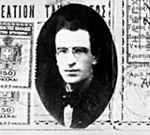
Tellos Agras
Tellos Agras (1899 - 1944). Tellos Agras, the pen name of Evangelos Ioannou, was born in Kalabaka, the son of schoolmaster Georgios Ioannou and Eirini Vlachou. He had a younger brother named Christos. In 1899, his family moved to Athens, and in 1906 they relocated to Lavrio, where the poet completed primary and secondary school. In 1907, he became a subscriber to the children's magazine "Diaplasis ton Paidon," making his first appearance at just eleven years old in the correspondence column. That same year, he took the only two trips of his life, one to Karystos and another to Chalkida. From 1911, he began writing regularly for the subscriber collaboration column of "Diaplasis" under the pseudonym Tellos Agras. His first poetic publication was "The Rock." In 1912, he enrolled in high school in Athens, living at the home of his mother's sister, Aristea Vlachou, until 1925 when his family moved to Athens. After his aunt's death, Agras kept her small house as a retreat. His collaboration with "Diaplasis ton Paidon" continued systematically, and the total volume of his youthful publications was substantial. In 1914, Xenopoulos planned to make Agras a regular contributor to the magazine, but these plans were postponed with the outbreak of World War I (they were realized in 1916). In 1916, he graduated from high school and enrolled in the Law School of the University of Athens, graduating in 1923. His first official appearance in the columns of "Diaplasis" was in May of the same year with the prose piece "Farewell." He subsequently collaborated with magazines such as "Lyra," "Vomos," "Neoi," and others. In 1918, he was awarded in the Sevastopouleio competition and in the short story competition of the London magazine "Hesperia." In 1921, he gave a lecture on Cavafy at the Greek Conservatory and published a translation of "Strophes" by Jean Moreas. In 1926, he released a second edition of translations from Moreas's work, including a study on the poetry of the French-speaking Greek poet and one on literary translation. From 1924, he worked at the Ministry of Agriculture, and in 1927 he was appointed to the National Library, where he remained until his death. He wrote for "Nea Estia" from its first year of publication and quickly became its editor-in-chief (resigning from this position in 1932 and taking over the correspondence column in 1936), while also publishing his writings in "Grammata," "Nea Zoi," "Alexandrian Art" (all three Alexandria-based magazines), the "Bulletin of the Educational Association," and many other publications. In 1928, he became a collaborator of the "Great Greek Encyclopedia of Pyrsos." In 1934, his first poetry collection, "The Bucolics and the Encomiums," was published. This was followed by his second collection, "Everyday Life (1923-1930)," in 1939, which was awarded the State Prize in 1940, while "Roses of a Day (1929-1944)" was published posthumously in 1966. In 1938, his father passed away, and Agras moved with his mother to Agathoupoleos Street, where he remained until the end of his life. The hardships of the German occupation further weakened his already fragile health. On the day of Liberation, he was struck by a stray bullet in the ankle. He was taken to Evangelismos Hospital, where he died in November 1944. Tellos Agras is considered one of the Greek poets of the interwar period, known as the neo-romantics or decadents (alongside Karyotakis, Kleon Paraschos, Napoleon Lapathiotis, Kostas Ouranis, and others). His poetic work is the result of a creative assimilation of the spirit of French symbolism and aestheticism (Moreas, Laforgue, Verlain, Mallarme, Baudelaire, etc.), as well as the Greek poetic tradition from folk songs to Ioannis Polemis, Kostis Palamas, Miltiadis Malakasis, and Constantine Cavafy. He operated within the frameworks of introspection, melancholy, morbidity, and pessimism of his contemporaries, adopting an idyllic contemplation of the past. However, thanks to his profound intellectual cultivation, he refused to succumb to despair and strove to hold onto the hope for a better tomorrow. It should also be noted that his critical work is valued for its particular acumen, sensitivity, deep knowledge of philosophy, and sufficient awareness of contemporary European literary theories, placing him at the forefront of modern Greek critical thought. For more biographical details on Tellos Agras, see Alexis Ziras, "Agras Tellos," World Biographical Dictionary 1. Athens, Ekdotiki Athinon, 1983, and Maria Stasinopoulou, "Chronology of Tellos Agras," Diavazo 104, 17/10/1984, pp. 14-21. (Source: Archive of Greek Authors, EKEBI).
-
Greek Fiction Books
-

All categories

Categories
 Greek Fiction Books
Μνήμη του Ηλία Βενέζη, Five Years Since his Death
Collective Work, 1999 , Responsibility
0
 Greek Fiction Books
Η Κριτική για τον Πέτρο Χάρη
Collective Work, 2009 , Kostas and Eleni Ouranis Foundation
0