Miltiadis Malakasis

Miltiadis Malakasis
Miltiadis Malakasis (1869-1943). Miltiadis Malakasis, son of Agamemnon and Zoe of the Kerasovitis family, was born in Messolonghi, descending from a lineage of fighters from the 1821 revolution in Pindos. His mother had eight children in total, but only Miltiadis and three daughters survived. His family was affluent, which allowed him to dedicate his life to literature. He spent his high school years in Messolonghi, Patras, and Athens, and under family pressure, he enrolled in the Law School of the University of Athens in 1888, from which he never graduated. As a student, he published poems initially in the Illustrated Estia and later in various literary magazines and newspapers (Dionysos, Techni, Panathinaia, Asty, Akropolis, etc.), while leading a social life and being a member of the Athenian Club. In 1899, he published his first poetry collection titled "Syndrimmata," dedicated to Ioannis Papadiamantopoulos (Jean Moreas), whom he met in 1897 during the latter's visit to Athens. He advocated for the establishment of the demotic language in written form as a member of the National Language Society, an organ of the demoticist movement. In 1908, he married Eliza, daughter of Epameinondas Deligiorgis (and cousin of Ioannis Papadiamantopoulos), with whom he lived in Paris from 1909 to 1915. In Paris, Malakasis joined Moreas' circle and came into contact with the French intellectual world of the time. He returned to Greece in 1915, having previously visited Germany and Constantinople. He was appointed as the dean of the Parliament Library, a position he held from 1917 to 1935 and from 1936 to 1937. In 1923, he was honored with the Award of Letters, and in 1925 he published a report on library science. In 1932, he was elected president of the Society of Greek Writers. Malakasis completed a total of ten poetry collections (one of which, "The Lady of the Tower," was in theatrical form). After his death, "Mesolongitika," a selection of his earlier poems, was published from his manuscripts. He was heavily influenced by his long-standing friendship with Moreas, incorporating romantic elements initially and later Parnassian, symbolist, and neoclassical elements into his work. He also engaged in poetic translation, notably translating Moreas' collection "Strophes," and prose writing. Special mention should be made of the influence Malakasis had on later poets. He was honored with the National Award of Letters and Arts. He died in Athens. For more biographical details on Miltiadis Malakasis, see Agra Tellos, "Malakasis Miltiadis," Great Greek Encyclopedia XVI. Athens, Pyrros, 1931 (also in the volume Tellos Agra, Critical Volume Two; Poetic Figures and Texts; Edited by Kostas Stergiopoulos, pp. 255-257. Athens, Hermes, 1981), Nea Estia LG', 1/6/1943, no. 384, Meraklis M.G., "Miltiadis Malakasis," Greek Poetry; Romantics - Palamas Era - Post-Palamas; Anthology - Grammar, pp. 326-329. Athens, Sokolis, 1977, Hartomatzidou - Liama I., "Malakasis Miltiadis," World Biographical Dictionary 5. Athens, Ekdotiki Athinon, 1986, and Koumaki Katerina, "Chronology of Miltiadis Malakasis (1869-1943)," Diavazo 357, 11/1995, pp. 130-133, and Giakos Dimitris, "Malakasis Miltiadis," Great Encyclopedia of Modern Greek Literature 9. Athens, Haris Patsis, n.d. (Source: Archive of Greek Writers, EKEBI).
-
Greek Fiction Books
-

All categories

Categories
0
 Greek Fiction Books
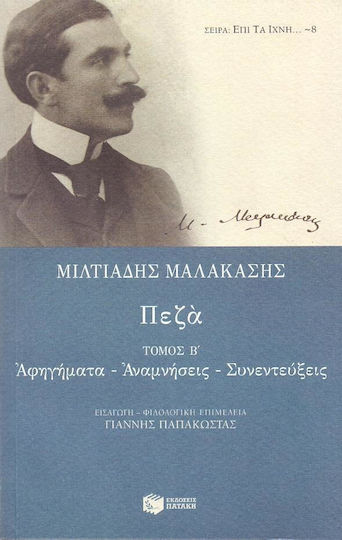
Πεζά, Narratives, Memories, Interviews
Miltiadis Malakasis, 2006 , Patakis
from8,48 € at 3 stores0