Ioannis Polemis

Ioannis Polemis
Ioannis Polemis (1860-1938). Ioannis Polemis was born in Athens, descending from a historical Byzantine family. He completed his general education in Athens and enrolled in the Law School, but soon abandoned his studies as he was early drawn to literature. He served as a clerk at the Ministry of Education, an undersecretary at the University of Athens, and a secretary at the School of Fine Arts. He was also the founder and first president of the Society of Playwrights. His first appearance in the literary field was in 1880 when he published his prose work "Rea Kyveli" in the magazine "Ai Mousai." Through the eponymous club, he came into contact with Palamas and the poets of his circle. This contact led Polemis to shift from the formal Greek language to the demotic Greek, in which he wrote and published his subsequent poems and prose in "Rambagas" and his first poetry collection titled "Poems" (1883). From 1884, he began writing under the pseudonym Guerrier for Emmanuel Roidis's "Asmodaios" and "Asty," and under his real name in "Evdomada," "Poikili Stoa," "Ethniko Imerologio" by Konstantinos Skokos, and elsewhere. In 1888, he published his second poetry collection titled "Winter Flowers" and in the same year left for studies in art history and aesthetics in Paris with a scholarship from the Municipality of Athens. In Paris, he met Legrand, Saint-Hilaire, Psycharis, Renan, and Coppée. He returned to Athens in 1890 and won the first prize at the Philadelphian poetry competition with his collection "Ruins," sharing the award with Kostis Palamas for his collection "The Eyes of My Soul." Until 1922, he continued to publish poems, always with success among readers, while his collection "Broken Marbles" was awarded the Prize of Letters and Arts in 1917. He also published anthologies and prose works, and engaged in theater, initially writing verse dramas with Byzantine themes in the demotic language (one of which, "Prokris," was performed at the Royal Theatre) and later one-act plays (which were awarded in the Averoff competition along with the three-act "King Aniliagos"), as well as multi-act plays. He translated works by Sappho, Anacreon, Theocritus, Euripides, Hugo, Mistral, Molière, Aristophanes, and others. He died in 1925 from bronchopneumonia. Ioannis Polemis's work is chronologically placed at the transition from the Romanticism of the First Athenian School to the New Athenian School. His writing is characterized by a melancholic mood reminiscent of the poetry of Achilles Paraschos. For more biographical details on Ioannis Polemis, see Agra Tellos, "Polemis Ioannis," Great Greek Encyclopedia 20. Athens, Pyrso, 1932; Yalourakis Manolis, "Polemis Ioannis," Great Encyclopedia of Modern Greek Literature 11. Athens, Hari Patsi, n.d.; Meraklis M.G., "Ioannis Polemis," Greek Poetry: Romantics - Era of Palamas - Post-Palamas; Anthology - Grammar, pp. 314-317. Athens, Sokolis, 1977; and h.s., "Polemis Ioannis," World Biographical Dictionary 8. Athens, Ekdotiki Athinon, 1988. (Source: Archive of Greek Authors, EKEBI).
-

Greek Fiction Books
-

All categories

Categories
 Greek Fiction Books
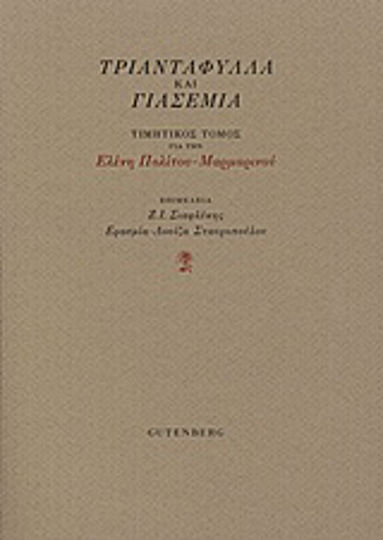
Τριαντάφυλλα και Γιασεμιά, Honorary Volume for Eleni Politou - Marmarinou
Collective Work, 2012 , Gutenberg
from35,00 € at 2 stores0