Herta Müller
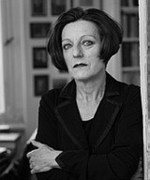
Herta Müller
Herta Müller was born on August 17, 1953, in the German-speaking village of Nitzkydorf, in the Banat region of Romania, as a member of the country's German-speaking minority. Her father served in the SS during World War II, and after the war, the Romanian Communist Party deported her mother to a Soviet labor camp. Müller studied German and Romanian literature at the University of Timișoara, where she joined the "Aktionsgruppe Banat," a group of idealists advocating for freedom of expression. She later worked as a translator in a factory but lost her job when she refused to collaborate with the secret police. During this time, she began writing her first collection of short stories titled "Niederungen" ("Lowlands"), which faced issues with the authorities and was only published in a censored form in 1982. Two years later, her novel "Druckender Tango" ("Oppressive Tango") was published, which, like her first book, denounced the hypocrisy, corruption, and oppressive spirit of the German minority in the countryside. While she had started working as a teacher, an uncensored copy of "Lowlands" was smuggled to the West and published in Germany by Rotbuch Verlag, receiving critical acclaim. During her visit to the Frankfurt Book Fair that followed, she openly criticized the Ceaușescu regime in Romania, leading to the ban on her books upon her return. In 1987, Müller permanently fled with her husband, Richard Wagner, to Germany, living since then in Berlin and Hamburg. Her subsequent works include: "Der Mensch ist ein grosser Fasan auf der Welt" ("The Passport," 1986), "Barfussiger Februar" ("Barefoot February," 1987), "Reisende auf einem Bein" ("Traveling on One Leg," 1989, Greek edition by Herodotus, 1993, about the adaptation challenges of political exiles crossing borders), "Der Teufel sitzt im Spiegel" ("The Devil is Sitting in the Mirror," 1991, a series of lectures at the University of Paderborn between 1989-90), "Der Fuchs war damals schon der Jager" ("The Fox Was Ever the Hunter," 1992, a novel based on her own script, also set in Romania), "Herztier" (novel, 1994), among others. Throughout this period, Herta Müller remained politically active and highly critical of her colleagues from former Eastern Europe who collaborated with their oppressive regimes (this was the reason she left the PEN Club, due to its decision to merge with its former East German branch). Her work has been honored with numerous awards, including the Aspekte Prize (1984), Ricarda-Huch Prize (1989), Marieluise-Fleisser Prize (1989), Kranichsteiner Literature Prize (1991), Heinrich Von Kleist Prize (1994), and the European Literary Prize (1995). In October 2009, she was awarded the Nobel Prize in Literature for "depicting the landscape of the dispossessed with the concentration of poetry and the frankness of prose," according to the announcement by the Swedish Academy.
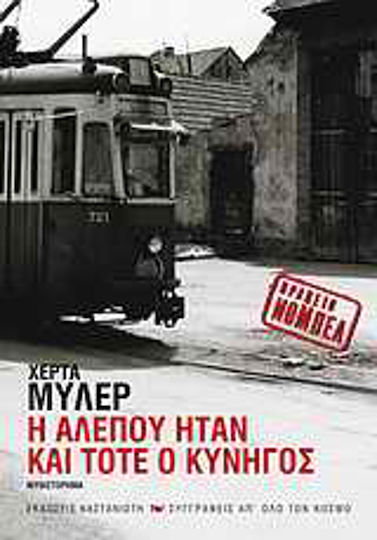 Greek Fiction Books
Η Αλεπού Ήταν και Τότε ο Κυνηγός, Novel
Herta Müller, 2011, Award Nobel , Kastaniotis Editions
0
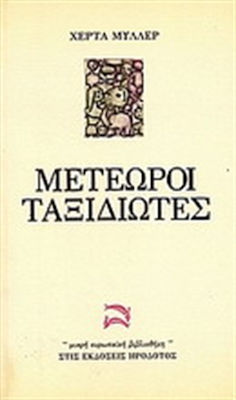 Greek Fiction Books
Μετέωροι Ταξιδιώτες
Herta Müller, 1993, Award Nobel , Herodotus
from10,06 € at 4 stores0
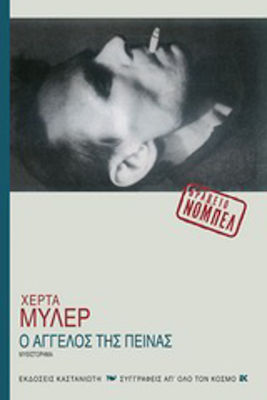 Greek Fiction Books
Ο Άγγελος της Πείνας, Novel
Herta Müller, 2010, Award Nobel , Kastaniotis Editions
from12,72 € at 2 stores0
0