Giorgis Paylopoulos
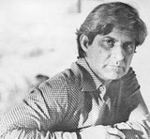
Giorgis Paylopoulos
Giorgis Pavlopoulos (1924-2008), a poet of the first post-war generation, was born in Pyrgos, Ilia, on June 22, 1924, and passed away on November 26, 2008, in his hometown where he lived permanently. He completed his primary and secondary education there. His studies at the Law School of the University of Athens were not completed. He worked as an accountant and secretary in private organizations. He first published his poems in 1943 in the magazine "Odysseus," which he co-published with friends in Pyrgos. His poems and writings were published in many Greek and international literary journals and anthologies. He collaborated with his friend, poet Takis Sinopoulos, on an experimental writing of joint poems, which Sinopoulos included in his work. He published the poetry collections: "The Cellar" (first edition: Hermes, 1971), "The Sack" (Kedros, 1980), "The Master Keys" (Stigmi, 1988), "Thirty-three Haikus" (Stigmi, 1990), "A Little Sand" (Nefeli, 1997), "Poems 1943-1997" (collected edition, Nefeli, 2001), "Where Are the Birds" (Kedros, 2004), and "Lest I Forget Them" (Kedros, 2008). He participated in cultural events in Greece, Cyprus, and abroad. His correspondence with his friend, novelist Nikos Kachtitsis, was published as "The Letters of Nikos Kachtitsis to Giorgis Pavlopoulos," Sokolis, 2002. He was an amateur painter and participated in the 19th Panhellenic Painting Exhibition. His poems have been translated into English, French, German, Spanish, Dutch, Italian, Polish, Russian, the USA, and Canada, and are included in the textbooks for Modern Greek Literature of the third year of high school. He was a founding member of the Society of Authors. Philologist and poet Tasoula Karageorgiou writes about the poet in the tribute of the literary magazine of Ilia "Oropedio" (issue 1, summer 2006): "The scholar of Pavlopoulos faces the following difficulty: it is impossible to quote some of his verses fragmentarily without doing injustice to their creator, and without injuring the body of the poem from which the verses are extracted. The reason is this: Giorgis Pavlopoulos is a creator of poetic myths, and communication with his poetry essentially presupposes treating the poem as a small and indivisible universe and the acceptance and respect by the reader of the rules of the fairy tale governed by its own laws: the abolition of logical order and the timeless and placeless function of the myth, elements that presuppose the reader's primarily experiential and not intellectual participation. [...] It is essentially narrative poetry, with stories strangely constructed with a pictorial technique and a cinematic perspective aptly served by a language "without embellishments," dense and expressive in its simplicity, from which unnecessary adjectives and figures of speech are absent, and in which the verb dominates. This language, which possesses the unadorned immediacy of folk myths, sometimes recalls echoes from folk songs. This, of course, does not mean that we do not encounter in Pavlopoulos's poetry poems in which historical memory is inscribed. After all, history severely marked his generation, the first post-war generation, a generation that, in any case, carried heavy historical burdens already in the prime of its youth." Even those works that refer to historical experiences are narrative poems in which history bears witness through a myth that lacks direct reference to place and time. [...] A detailed bibliography of the poet, covering the years 1940-2005, was published by Giannis Xourias in the Cypriot magazine "Mikrofilologika," issue 5, 2005 (and in a summarized form in the same issue of the magazine "Oropedio").

0