Julius Evola

Julius Evola
Julius Evola was born in Rome on May 19, 1898, into a noble family of Sicilian descent. He was a principal exponent of the Inner Tradition, leaving behind a remarkable body of work characterized by a series of studies on Buddhism, Hinduism, Yoga, and Eastern philosophies, while also delving into hermetic tradition, alchemy, and spiritualism. These are different paths leading to enlightenment. Ancient traditions, which, along with Greek, Roman, and Northern mythology—perceived as a kind of prehistory—extend to the chivalric and occult narratives of the Middle Ages. An aristocratic cultural heritage against the universalism of globalization in the modern era, viewed through the lens of Metaphysics, not only in the simple etymological and philosophical sense of the term "beyond the physical," but as an experience that is "supra-psychological and supra-physiological." This may be what makes Evola's works difficult for the general public to understand. What he writes is not only studied in the essential sense of the word but also experienced, and conversely, what he writes essentially requires at least to be studied. This observation is confirmed by the founding in 1927 of the Ur Group (Gruppo di Ur) by Evola himself, along with other Italian esotericists and intellectuals of the time. He also published the monthly publication of the same name (Ur, 1927-1928) and subsequently the monthly bulletin Krur (1929). His philosophical work is complemented by a series of political books, also of spiritual and traditional orientation, the core of which is the trilogy "Revolt Against the Modern World," "Men Among the Ruins," and "Ride the Tiger." These writings serve as survival manuals for the aristocrats of the soul in the modern era, which Evola, deeply influenced by Hinduism and the theory of the Yugas, perceives as the dark age (Kali Yuga), the age of the end of this civilization, a time of decline and disintegration. As Evola himself admitted, his ideas and views were shaped under the influence of Plato, Nietzsche and his theory of the "Übermensch," Otto Weininger and his theory of polarity, as well as the metaphysical quest for the absolute tragically expressed by Michel Staedter. The influence of Otto Braun, Meister Eckhart, Oswald Spengler, and the great French intellectual René Guénon is also significant. Evola was not merely a scholar. His literary work is accompanied by a series of poems ("Raaga Blanda," 1969) and artworks that deeply influenced the Dadaism movement to which he belonged. In 1963, an exhibition of all his works was organized for the first time at the "Medusa" gallery in Rome, while most of these works today adorn both private collections and the Galleria Nazionale d'Arte Moderna in the Italian capital. Evola also actively intervened in the political life of his time, expressing opposition to both American capitalism and the Bolshevism of the then Soviet Union. Many, due to his aristocratic ideas, hastily labeled him as the official intellectual of fascism, something that was countered by his radical and heretical discourse combined with his revolutionary declarations. Very soon, the semi-annual publication La Torre (1930) was banned by a decree from Mussolini himself. In La Torre, Evola launched a fierce critique of the political regime of the time, its relationship with the Catholic Church, the industrial magnates, and its populist appeal to the masses. In contrast, Evola's interest in the structure of the internal National Socialist caste system is described as rightly romantic and particularly spiritual, even predicting the inclusion of ethnically foreign non-Germans into its ranks long before the onset of World War II. Immediately after the fall of Fascism and the Italian armistice, he took refuge in the then free Northern Italy, while frequently visiting Germany and Austria. In March 1945, while enjoying his daily walk on the streets of Vienna, Julius Evola was seriously injured during a severe Allied bombing, an accident that resulted in the paralysis of his lower limbs for the remaining 30 years of his life. He returned to Italy in 1948, where he dedicated himself entirely to his writing. Julius Evola died on June 11, 1974. His body was cremated, and his ashes were scattered, as he wished, on the icy peaks of Mount Rosa so that he could continue his beloved practice of mountaineering there.

 Greek Fiction Books
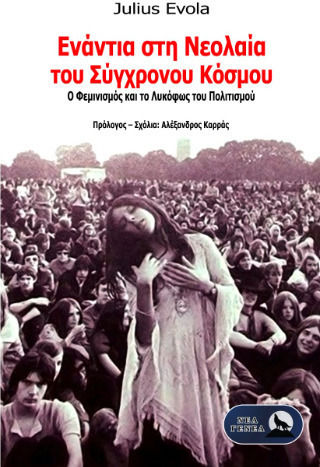
Ενάντια Νεολαία του Σύγχρονου Κόσμου
Julius Evola, 2025 , New Generation
from16,22 € at 2 stores0