
Alfred de Musset
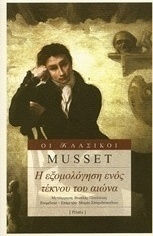
Alfred de Musset was born in 1810 in France and passed away in 1857. Gifted with rare maturity from his early youth, he was accepted into the circles of Nodier as early as 1828, connected with Vigny and Sainte-Beuve, and received flattering comments for his literary work. His collection "Stories of Spain and Italy" (1830) revealed a vigorous romanticism characterized by the pursuit of a spectacular local color, the depiction of violent passions, and the elegance of a master of versification. A genius spirit in love with freedom, indifferent to schools and trends, he was destined to gift French theater with some of its masterpieces, such as "A Caprice," "The Venetian Night," and "A Spectacle in an Armchair." Affirming his independence from the new romantic spirit, he sought to rediscover the profound and sincere inspiration ("what the artist or poet needs is emotion") and indirectly expressed himself through the heroes of his works ("The Caprices of Marianne" - 1833; "Fantasio" - 1834; "Lorenzaccio" - 1834; "The Candlestick" - 1835; "You Never Can Tell" - 1838). The volatile nature of his characters, their complex personalities where the desire for purity and the longing for the ideal are inextricably linked with abandonment to corruption and despair, as well as the arbitrary mixing of genres, initially shocked audiences. This dual-faced persona is Musset himself, and his work is the most faithful reflection of his inner turmoil. Thus, "Don't Trifle with Love" (1834) recalls with its title Musset's "mad love" for George Sand. This painful adventure (1833-1835), which has been transferred into the novel "The Confession of a Child of the Century" (1836), also inspires the lyrical outpouring that permeates the works "Nights" (1835-1837), "Letter to Lamartine" (1836), "Remembrance" (1841). From then on, the poet, disillusioned and ill, would successively produce short stories ("The Story of a Rare Species") or poetic fantasies ("Three Steps from the Rosy Marble") and works more bitter and troubled ("Hope in God"). Masterful in handling witty and ironic play, Musset equally knew how to express the outbursts of passion or what was his internal drama: the temptation of debauchery and the nostalgia for innocence that inhabit "his bleeding heart, full of flame and sorrow" (Sainte-Beuve).


 Greek Fiction Books
 Greek Fiction Books
 Greek Fiction Books
 Greek Fiction Books