Dimitrios Nikolareizis
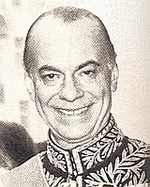
Dimitrios Nikolareizis
Dimitrios Nikolareizis was born in 1908, a descendant of an old family from Samos. He was the second son of the tobacco merchant and shipowner Ioannis (John) Nikolareizis, a descendant of the fighters of 1821, and Aikaterini Vliamou. After completing his high school studies at the Pythagorean Gymnasium of Samos, he attended the Law School of the University of Athens and subsequently studied art history for a year at the University of Florence. In February 1936, after a competitive examination, he entered the diplomatic service and served in various positions at the Ministry of Foreign Affairs: vice-consul in Argyrokastro (1940-1941), followed the exiled Greek government on May 10, 1941, to the Battle of Crete, Alexandria, South Africa, and London. He served as consul in Hamburg (1948-1950), chargé d'affaires in Bonn (1950-1952), deputy advisor of Greece to NATO in Paris (1954-1956), chargé d'affaires and general consul in London (1956-1958), ambassador in Belgrade (1960-1964), ambassador in London (1964-1967), and director of the B' Political Directorate of the Ministry of Foreign Affairs (1967-1968). After his forced departure from the Diplomatic Corps in 1967, he collaborated for a short period with the newspaper "Akropolis," mainly through correspondence. For his services, he was honored with various decorations (Silver Cross of the Redeemer, Order of George, among others). He passed away in Athens in 1981. He first appeared in our literary circles in 1925, at the age of seventeen, with a translation of a poem by Alphonse Daudet in a literary magazine of Samos. A colleague and friend of George Seferis, he contributed to the publication of the magazine Nea Grammata, an expressive organ of the Generation of the '30s. After wavering between literature and criticism, he devoted himself to the latter, serving it discreetly; "a stranger to noise and blatant advertising and self-promotion," noted Vassos Varikas, while Seferis wrote to Katsimbalis in 1936 about Nikolareizis that "he wavers between diplomacy and perfection." From his very first essay in 1930, he demonstrated his virtues: a sensitive and competent reader of literature, astute as its critic, he sought to highlight "the human depth" expressed by each author. Although his output is impressively small, it has (even today) inversely proportional value, so Varikas's judgment remains valid: Nikolareizis stands out "as one of the brightest critical consciences." During his lifetime, he compiled his essays and critical works into two books: "Ugo Foscolo and Andreas Kalvos" (1961), "Essays of Criticism" (1962, 2nd edition - 1983) with the apt inscription "One must speak of the essential" from Aeschylus's Seven Against Thebes. The "Essays of Criticism" were awarded the L. Goulandris Prize in 1963, one of the prizes of the Group of Twelve.
-

Greek Fiction Books
-

All categories

Categories
 Greek Fiction Books
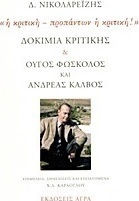
Δοκίμια Κριτικής. Ούγος Φώσκολος και Ανδρέας Κάλβος: "η Κριτική - Προπάντων η Κριτική!"
Dimitrios Nikolareizis, 2011 , Agra
from16,10 € at 2 stores0