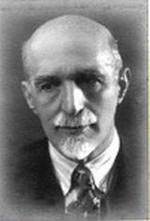
Zacharias L. Papantoniou
Zacharias Papantoniou (1877-1940). Zacharias Papantoniou was born in Karpenisi, the son of the teacher Lambros Papantoniou and Eleni Iliokaftou from Karpenisi. He had three siblings: Charilaos, Thanasis, and Sofia. In Karpenisi, he received his early education, and in 1890, he moved with his family to Athens, where he completed high school, took painting lessons, and enrolled in the Medical School of the University, although he did not graduate. From his student years, he turned towards writing and journalism, and at the age of just sixteen, he began writing for V. Gavriilidis' "Akropolis." Until 1898, when his first poetry collection titled "War Songs" was published, he continued to collaborate with magazines and newspapers such as the "Newspaper of Discussions," "Chronos," and "Skrip," where he served as editor-in-chief from 1900 to 1905. In 1904, he became one of the first members of the "National Language" society, aiming to defend the demotic language (alongside Miltiadis Malakasis, Lambros Porphyra, Konstantinos Chatzopoulos, Andreas Karkavitsas, Ioannis Kondylakis, and others). For the National Language, he drafted the declaration "To the Greek Nation" the following year, outlining its objectives. From 1908 to 1911, he was in Paris as a correspondent for the newspaper "Empros" by Aristides Kyriakou. He also wrote for French newspapers and became acquainted with new artistic movements. After returning to Athens, he left journalism (with the sole exception of writing chronicles for the newspaper "Empros" until 1914) and was distinguished in a painting exhibition at Zappeion for sketches and cartoons he had occasionally published in various magazines. From 1912 to 1916, he served as the prefect in Zakynthos, the Cyclades, Kalamata, and Sparta. As a prefect, he promoted the idea of organizing a labor union in Syros and organized the first Pan-Ionian Congress for the fiftieth anniversary of the Union of the Ionian Islands and reacted, along with prosecutor A. Regos, against the 1916 excommunication of Venizelos. This last initiative cost him his position and led to a trial, in which he was acquitted. He continued to engage in art and criticism, and he was awarded alongside Stelios Sperantzas and Eleni M. Negreponti (later Eleni Ourani) in the official Military Poems competition announced by Eleftherios Venizelos. In 1917, his father passed away, and the following year he wrote (in collaboration with D. Andreadis, Al. Delmouzos, P. Nirvana, and M. Triantafyllidis, with illustrations by P. Roubos) "The High Mountains," a work intended as a reader for the third grade of primary school (following an assignment by the Ministry of Education of the revolutionary government of Venizelos). That same year, he assumed the role of president of the National Gallery, ensuring its enrichment with works by many Greek painters and engravers (Gyzis, Parthenis, Maleas, Lytras, Theotokopoulos). The following year, his brother Thanasis, who had been suffering from severe mental disorders since the age of twenty-two, committed suicide at the age of thirty-nine. In 1920, he published the children's poetry collection "The Swallows," dedicated to his brother, which was reissued in 1931 under the title "Children's Songs." After the overthrow of the Venizelos government, the new government decided to publicly burn the textbooks of the educational reform, including "The High Mountains." In 1923, Papantoniou published his poetry collection "Prose Rhythms" and the three volumes of "Modern Greek Readings" for the early grades of elementary school. He was awarded the National Prize for Literature and Arts and was appointed as a professor at the Amalieion Orphanage and the School of Fine Arts. In the same year, he traveled to Europe, Constantinople, and Mount Athos as part of his duties as the director of the National Gallery. Four years later, his short story collection "Stories" was printed, and from 1929 to 1937, he published the play "The Oath of the Dead," adapted from the folk song "Of the Dead Brother," the poetry collection "The Divine Gifts," the historical essay "Othon," travel impressions "Mount Athos," and two short story collections titled "Byzantine Matins" and "The Sacrifice." In 1938, he was appointed a member of the Academy of Athens in the literature department, from which he submitted his first report in the demotic language, an act that sparked reactions. Zacharias Papantoniou passed away on the first day of February 1940 from cardiac arrest. Many of his unpublished works were released posthumously. For more biographical details on Zacharias Papantoniou, see Agra Tellos, "Papantoniou Zacharias," Great Greek Encyclopedia 19. Athens, Pyrso, 1932 (also in the volume Tellos Agra, Critical Volume Three; Forms and Texts of Prose; Literary Editing Kostas Stergiopoulos, pp. 308-312. Athens, Hermes, 1984), Athanasiadis Tasos, "Papantoniou Zacharias," Great Encyclopedia of Modern Greek Literature 11. Athens, Hari Patsi, n.d., Athanasopoulos Vangelis, "Zacharias L. Papantoniou," Our Older Prose IA (1900-1914), pp. 240-268. Athens, Sokolis, 1998, Meraklis M.G., "Zacharias Papantoniou," Greek Poetry; Romantics - Palamas Era - Post-Palamas; Anthology - Grammar, pp. 350-353. Athens, Sokolis, 1977, Kalantzopoulou Vicky, "Papantoniou Zacharias," World Biographical Dictionary 8. Athens, Ekdotiki Athinon, 1988, and Malafantis Konstantinos Dim., "Chronology of Zacharias Papantoniou," Diavazo 285, 15/4/1992, pp. 58-63.
(Source: Archive of Greek Authors, EKEBI).
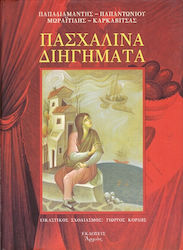


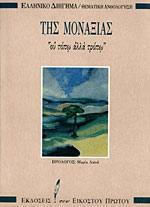

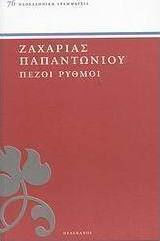
 Greek Fiction Books
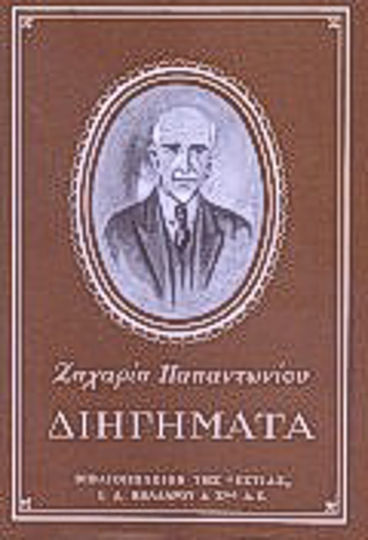 Greek Fiction Books