
Karl Polanyi
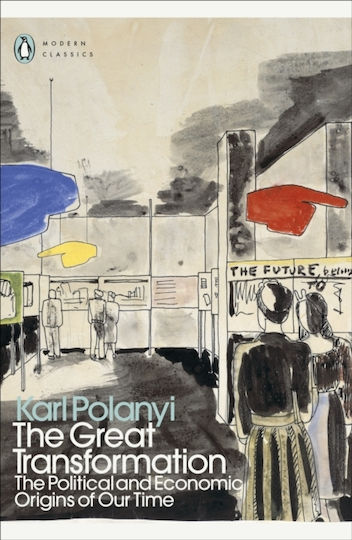
Although Polanyi's life was nomadic—he never settled into a comfortable academic position—his work had a significant influence on his contemporaries. Polanyi (1896 - 1964) was born in Vienna and raised in Budapest, where he studied and frequented the circles of Karl Mannheim and Georg Lukács. During World War I, he was captured on the Russian front, and upon his release, he returned to Vienna and engaged in journalism. He emigrated to England in 1933 and made a living by giving private lessons. In 1940, during a lecture tour in the U.S., he accepted an offer from Bennington College to teach there. It was then that he wrote his opus magnus, "The Great Transformation" (1944).
In 1947, he was invited to teach in the sociology department at Columbia University. However, because his wife, Ilon Duczynska, had played a significant role in the failed Hungarian revolution of 1920, she was denied a visa to visit the U.S. As a result, Polanyi was compelled to reside in Toronto, Canada, and travel to the U.S. to teach; this continued for the rest of his life.
Despite benefiting greatly from interdisciplinary research at Columbia, he never integrated into academic circles. He remained an exile throughout his life—from Hungary, from Austria, from America, from the academic environment...
Major works:
- "The Great Transformation," 1944
- "Trade and Markets in Early Empires," in collaboration with K. Conrad, K. Arensburg, H. W. Pearson, 1957
- "Dahomey and the Slave Trade," in collaboration with A. Rotstein, 1966
- "Primitive, Archaic and Modern Economics: Essays of Karl Polanyi," 1968
- "The Livelihood of Man," in collaboration with H. W. Pearson, 1977.

 Business Books