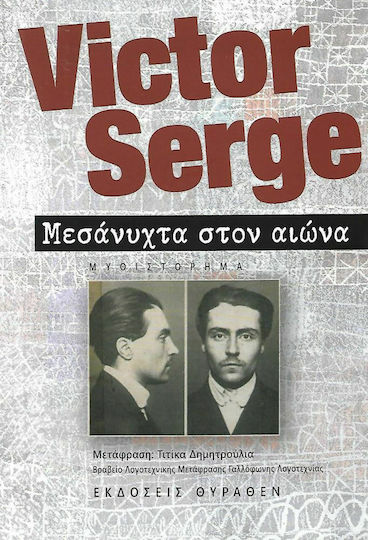
Victor Serge
Victor Serge (1890-1947) was born in Brussels to Russian parents in exile. He joined the anarchist ranks in France and Spain, returned to Russia after the Revolution, aligned himself with the Bolsheviks, met Trotsky, was arrested, and sent to a concentration camp in the Urals. In 1936, he returned to Europe and continued his collaboration with Trotsky, following him to Mexico during World War II.
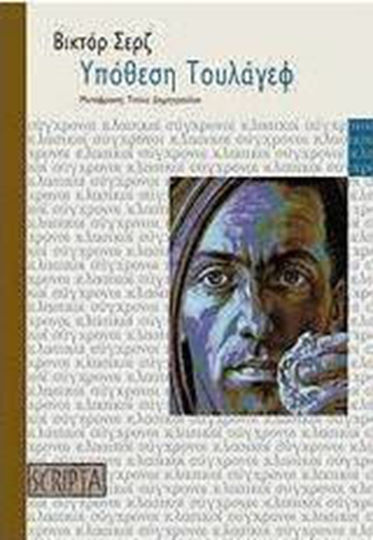
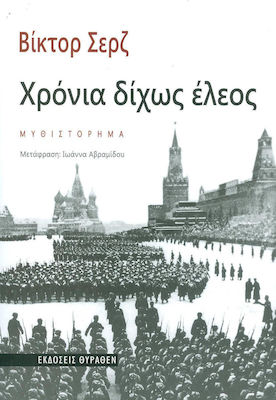
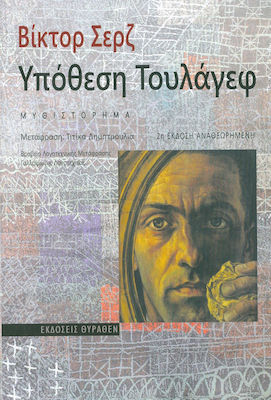
A critical piece by Anastasios Vistonitis in the newspaper "To Vima" on July 22, 2007, provides detailed insights into the tumultuous life of Victor Serge: "His real name was Victor Lvovich Kibalchich. His father fled Russia to avoid execution for participating in the plot to assassinate Tsar Alexander II. The Russian anarchists of the time (the Narodniks—from the Russian word 'narod' meaning 'people') assassinated Alexander II by throwing a bomb into his carriage. That bomb was made by Nikolai Kibalchich, a relative of Serge on his father's side. The assassination of Alexander II marked the end of an era that began with the Decembrists in 1825, continued with Chernyshevsky, Herzen, and Bakunin, and created the student movement (Narodniks) in the 1870s, eventually leading to terrorism. From this tradition emerged the Bolsheviks, which is why their views on revolutionary violence stem from there. Serge did not attend school but studied in his father's library, who considered secular education 'stupid bourgeois instructions for the poor.' He learned life in the poor neighborhoods of Brussels, where, in his adolescence, he worked as a photographer's assistant to contribute to the meager family budget. He was an anarchist from then on. In 1908, Victor Lvov Kibalchich went to Paris, became a member of the anarcho-autonomous terrorist organization that the bourgeois of the time called the Bonnot Gang, was arrested, and sentenced to five years in prison (1912-17), while almost all his comrades were executed by guillotine. Upon his release, the French authorities deported him. The young Kibalchich went to Barcelona, where he first used the pseudonym Serge in his writings. Despite his connection with the Spanish anarchists, when the October Revolution broke out, he felt that history was being rewritten. He left Barcelona, returned to France, and tried to contact the forces of the Russian army. However, the French arrested him again, threw him into a concentration camp, and later exchanged him for French prisoners held by the Soviets. In 1919, Serge arrived in Red Petrograd and transitioned from an anarchist to a full-fledged Bolshevik propagandist. He participated in the civil war against the Whites as a machine gunner and later acted as an agent of the Soviet secret services in Romania. When the internal party conflict between Stalin and Trotsky erupted, he sided with the latter. After the Stalinists prevailed, they expelled him from the party, arrested him, and, along with his young son Vladi (who would later excel as a painter in Mexico), exiled him to Orenburg in Siberia. In 1935, in Paris, the Organization for the Protection of Culture, which included Romain Rolland, André Malraux, and André Gide, called for his release." Victor Serge wrote in French. His most well-known books include the novels "Les Hommes dans la prison" (1930), "Naissance de notre force" (about the years following the October Revolution, 1931), "L’Affaire Toulaev" (about the Stalinist purges in Moscow during the 1930s), "Ville conquise," "S’il est minuit dans le siècle," "Les Derniers temps," and "Les Années sans pardon." His memoirs, "Mémoires d'un révolutionnaire (1901-1941)," were first published in translation in America in 1945. He also wrote a biography of Trotsky, "Vie et mort de Trotsky," and political texts such as "L’An I de la Révolution russe," "Les Anarchistes et l’expérience de la révolution russe," "La Ville en danger: l’an II de la Révolution," "Destin d’une révolution: U.R.S.S. 1917-1937" (1937), "Portrait de Staline" (1940), "Le Nouvel impérialisme russe" (1946), "La Tragédie des écrivains soviétiques" (1947), as well as articles in anarchist newspapers and magazines, among others.


 Greek Fiction Books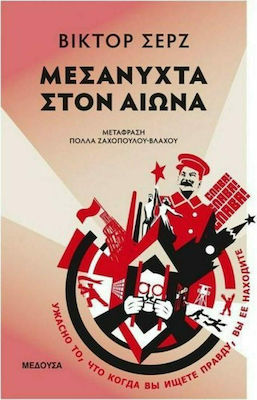
 Greek Fiction Books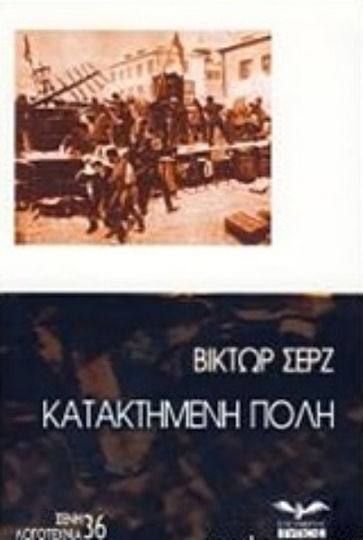
 Greek Fiction Books