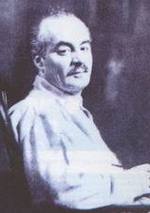
Kahlil Gibran
Kahlil or Khalil Gibran (1883-1931), a poet, thinker, and painter, became widely known through his book "The Prophet." He was born in Bsharri, Lebanon, to a poor family of Maronite Christians. In 1895, after his father's imprisonment and the confiscation of their property by the Ottoman authorities, his family was forced to emigrate to the United States, settling in Boston, an area with a large Lebanese community. Due to financial hardships during his childhood, he had not attended school and was taught Arabic at home. He enrolled in an English-speaking school in the area. In 1898, he returned to Beirut, where he attended college for four years to reconnect with his cultural roots. Meanwhile, his talent in painting had already attracted the attention of avant-garde photographer, artist, and publisher Fred Holland Day in Boston, who encouraged his efforts. In 1904, he organized his first painting exhibition in Boston, during which he met Mary Elizabeth Haskell, eight years his senior, with whom he formed a lifelong friendship. In 1908, he went to Paris to study for two years under Auguste Rodin, where he also met his loyal friend, sculptor Youssef Howayek. While Gibran's early works were written in Arabic, most of his works after 1918 were written directly in English. As a writer, he sought to bridge Eastern and Western cultures with his pen. Living in America, he endeavored, like a prophet, to preserve the Greco-Christian cultural tradition of humanism, whose abandonment was more than evident, while simultaneously reconnecting Western people with the wisdom hidden within them. Gibran also participated in the "immigrant poets" movement - Al-Mahjar - in New York, alongside notable Lebanese-American writers such as Ameen Rihani (the "father" of Lebanese American literature), Mikhail Naimy, and Elia Abu Madi. Gibran rewrote "The Prophet" - a composition of 23 poetic reflections - several times before it was finally published in 1923. Written by him in English, it is the book that made him most famous and saw many reprints. He died in April 1931 in New York from tuberculosis and cirrhosis of the liver and was buried in his homeland the following year by Mary Elizabeth Haskell, according to his last wish. His most well-known books include: "Ara'is al-Muruj" ("Nymphs of the Valley" or "Nymphs of the Spirit," 1906), "al-Arwah al-Mutamarrida" ("Rebellious Spirits" or "Unyielding Souls," 1908), "al-Ajniha al-Mutakassira" ("Broken Wings," 1912), "Dam'a wa Ibtisama" ("The Tear and the Smile," 1914), "The Madman" ("The Madman," 1918), "al-Mawakib" ("The Procession," 1919), "al-'Awasif" ("The Storm," 1920), "The Forerunner" ("The Forerunner," 1920), "al-Bada'i' waal-Tara'if" ("The New and the Marvellous," 1923), "The Prophet" ("The Prophet," 1923), "Sand and Foam" ("Sand and Foam," 1926), "The Son of Man" ("The Son of Man," 1928), "The Earth Gods" ("The Earth Gods," 1929), "The Wanderer" ("The Wanderer," 1932), "The Garden of the Prophet" ("The Garden of the Prophet," 1933), among others.

 Greek Fiction Books
 Greek Fiction Books
 Greek Fiction Books