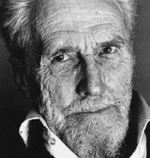
Ezra Loomis Pound
Ezra Pound was born in Hailey, Idaho (1885), grew up in Wyncote, Pennsylvania, and attended Hamilton College and the University of Pennsylvania. He briefly taught French and Spanish at Wabash College in Indiana but was dismissed after offering shelter to a penniless dancer one night. He immediately moved to Europe (1907). He spent a year in Venice, where he published his first collection, "A Lume Spento" (1908). That same year, he settled in London and began making provocative appearances in artistic circles. There, he published his collections "Personae" and "Exultations" (1909), leading the American poetic movement of "Imagism," which established a poetry that was simple, unadorned, objective, and elliptical. In 1914, he married Dorothy Shakespear, with whom he had a son (1926), and later left her to be with pianist Olga Rudge, his lover and loyal friend for the rest of his life. Their relationship resulted in a daughter, Princess Mary de Rachewiltz. In the years leading up to World War I, he was at the forefront of the Imagism and Vorticism movements and used his influence to bring to the forefront the works of great writers such as James Joyce, William Carlos Williams, Robert Frost, and others, works that contributed to the formation of Modernism. In 1920, Pound moved to Paris and came into contact with a multitude of artists, musicians, and writers. He encouraged Joyce and Eliot to publish their works and even edited nearly half of Eliot's "The Waste Land," giving it its final form. He also engaged in music, composing (both music and libretto) the opera "Francois Villon" and was among the first in our century to rediscover Vivaldi. In 1924, he moved to Italy, where World War II found him fervently defending Mussolini, expressing anti-Semitic sentiments, and condemning American involvement through radio broadcasts and newspaper articles. A contradictory nature with tragic fluctuations from tenderness to self-destruction, he could help his friends from his own meager resources or develop his own economic theory of social credit, study dead languages for years to translate or paraphrase ancient texts from the original, or vociferously support Mussolini and denounce Jews from the Rome radio station. These regular broadcasts continued throughout World War II. He was subsequently arrested (1945) by American troops who liberated Italy, isolated in an open-air cage with barbed wire in Pisa, and transported to Washington (1945) to stand trial for treason. He was deemed mentally unfit for trial and was confined to a psychiatric hospital. He was released (1958) and returned to Italy the same year. He died in Venice on November 2, 1972.


 Greek Fiction Books
 Greek Fiction Books