Simone Weil
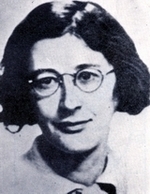
Simone Weil
Simone Weil was born in 1909 in a suburb of Paris to Jewish parents and graduated from the Ecole Normale Superieure in 1931 with a degree in philosophy. Possessing a vast breadth of knowledge and primarily concerned with the human condition, she developed an active social engagement alongside her writing activities. She joined the labor union movement in Poitiers, which began in 1932. Gifted with rare intelligence and insight, she was troubled by the increasing dominance of the state's bureaucratic machinery, which she saw as a new form of social oppression over the individual. In 1934, driven by her desire to understand firsthand the conditions of labor and the various problems faced by the working class, as well as her innate inclination to share in the suffering of the less socially privileged, Simone Weil left her teaching position to work as a simple factory worker. Her experiences during this time culminated in the book "The Working Condition," which, together with her diary entries documenting her arduous tenure in factory life, forms her moral and philosophical conclusions. The events of the era and her struggle for the human cause kept her at the center of the conflict. Concurrently, Simone Weil experienced an intense internal journey in her quest for truth, leading her to extraordinary experiences of mystical clarity. Although she grew up in an agnostic environment and went through a conscious revolutionary period both philosophically and politically, she humbly accepted the inner revelations that expanded her thinking from universal to cosmic dimensions. As a war refugee, first in Marseille, then in New York, and finally among the Free French in London, she documented the human condition with precision and absolute honesty, as informed by her new Christ-centered perspective. During this period, she delved deeply into Greek thought and developed strong intuitions about the mission of Greek philosophy as a precursor to the "coming word." Her other works include: "Pre-Christian Intuitions," "Notebooks," "Oppression and Liberty," "The Greek Source," "Waiting for God," "Supernatural Knowledge," "Saved Venice" (an unfinished tragedy), "The Need for Roots," and others. "The Need for Roots" was written by Simone Weil in 1943, shortly before her death in a sanatorium in England. This book, which is a declaration of society's duties towards the human being in fulfilling their spiritual and physical needs, became her spiritual testament. Her excellent essays are no less her spiritual testament, as is every other testimony of hers. Albert Camus, specifically regarding the significance of "The Need for Roots," wrote characteristically: "I cannot imagine a renaissance for Europe that does not take into account these demands as defined by Simone Weil."



0

0

0