Ploutarchos
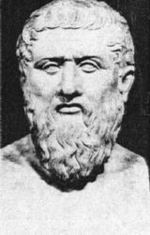
Plutarch (c. 45 - c. 120 AD) hailed from a wealthy aristocratic family in Chaeronea, Boeotia, where he was born and spent most of his life. He studied at the Academy of Athens and traveled throughout Greece, Alexandria, Asia Minor, and Italy. He visited Rome at least twice, where he became associated with circles of the imperial court. Highly respected, he was honored with various public offices. For "many Pythian Games," at least twenty years, he served as the chief priest of the Oracle of Delphi. He is renowned as the great biographer of antiquity, thanks to his "Parallel Lives of Noble Greeks and Romans," fifty of which were written, with 48 surviving. His work also includes approximately two hundred texts of various themes, essays, speeches, and dialogues, collectively given the title "Moralia," not entirely aptly. The influence of Plutarch's work was immense. It has been said that through his writings, all subsequent generations have come to know Greek and Roman antiquity. Particularly between the 16th and 18th centuries, his dissemination among educated European circles was comparable to that of the Bible. Admirers and those who drew from his work in recent centuries include Erasmus, who translated "How to Tell a Flatterer from a Friend" into Latin and dedicated it to Henry VIII; Montaigne, who was inspired by the "Moralia" for his "Essays"; Shakespeare, who based his Roman tragedies on the "Lives"; Rousseau and Goethe, who considered Plutarch among their favorite authors; Beethoven, who esteemed him as much as Homer and sought solace in his work when he began losing his hearing; Emerson and the Transcendentalists; Cavafy, in "The God Abandons Antony," "Alexandrian Kings," among others, while the "Parallel Lives" was Napoleon's favorite reading. The study of Plutarch was largely abandoned in the 19th century, mainly because his work was deemed unreliable for the historical reconstruction of the Greco-Roman past. However, Plutarch was less concerned with historical accuracy than with the character and psychology of his heroes, as well as the moral dimension of their actions. In the last decades of the 20th century, interest in Plutarch's work was somewhat rekindled, though it remained primarily within the academic community.