Mikis THeodorakis
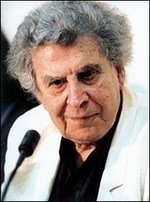
Mikis THeodorakis
Mikis Theodorakis was born in Chios. From a young age, he had a passion for music and wrote his first compositions at the age of thirteen. During the occupation of Greece by German, Italian, and Bulgarian forces, he was first arrested in Tripoli in 1942 by the Italian occupiers. In the following years, he was arrested and tortured again. Once released, he went underground in Athens and joined the National Liberation Front (EAM). While working for the Resistance, he also attended classes at the Athens Conservatoire under Philoktitis Economidis. After the Liberation, Theodorakis participated in the Greek Civil War from 1945 to 1949. He was arrested multiple times. On March 26, 1946, during a demonstration, he was beaten so severely by the police that he was presumed dead and taken to the morgue. He was first exiled in 1947 to Ikaria and in 1948 was transferred to Makronisos, a hell on earth established by 20th-century humans to eliminate those with differing views. After enduring horrific torture, Theodorakis was one of the few who survived this ordeal, although he continued to suffer from the "Makronisos fever" a decade later. In 1950, after exams at the Conservatoire, he received his diploma in harmony, counterpoint, and fugue. On May 5, his work "Asi-Gonia" was presented. In 1953, Mikis married Myrto Altinoglou, and the following year he received a scholarship to study in Paris. Mikis enrolled at the Paris Conservatoire with professors Eugene Bigot and Olivier Messiaen. In 1957, his work "Suite No. 1 for Piano and Orchestra" won a gold award at the Moscow Festival. "Antigone" (choreographed by John Cranko at Covent Garden), "Les amants de Teruel" (Ludmila Tcherina Ballet), and "Le feu aux poudres" achieved great success in Paris and London. When Theodorakis achieved international recognition as a young classical composer, he discovered Greek folk music. He composed "Lipotaktes" with lyrics by his brother Giannis and "Epitaphios" with poetry by Yiannis Ritsos, a work that marked the beginning of the renaissance of Greek music and led his homeland to a cultural revolution, the effects of which are still evident today. The Right in Greece considered him one of its greatest enemies. When Dr. Grigoris Lambrakis ("Z") was assassinated, Theodorakis took the lead of the Lambrakis Democratic Youth, which grew to 50,000 members and became the largest political organization in Greece. Theodorakis was elected to Parliament and, along with the "Lambrakides," established over two hundred cultural centers in his country. He composed tirelessly, using the finest texts of 19th and 20th-century Greek literature. The coup by Papadopoulos and his clique (April 21, 1967) forced Theodorakis to go underground again, from where, two days after the coup, he issued the first call for resistance. He was arrested on August 21, 1967, and placed under house arrest with his family in Vrachati and later in Zatouna, a mountainous village in Arcadia (from which the cycle of compositions "Arcadies" I-XI originated). Subsequently, he was transferred to the Oropos concentration camp and eventually exiled from Greece, following numerous solidarity initiatives led by Dmitri Shostakovich, Leonard Bernstein, Arthur Miller, even Harry Belafonte, and many other figures from various countries. On April 13, 1970, Theodorakis arrived in Paris. As the head of the "Patriotic Front," he continued his struggle. He met Neruda. Tours around the world and thousands of concerts dedicated to restoring democracy in Greece made him a living symbol of resistance against the dictatorship. He triumphantly returned to Greece on July 24, 1974. Theodorakis once again became a target of attacks, this time from the Left, because he supported Karamanlis in his efforts for a smooth transition to democracy and out of fear of a new coup that would crush the fragile flower of democracy. In 1980, he self-exiled to Paris, focusing on his symphonic work from the 1950s. He completed the composition of "Canto General," which, along with "Zorba" and "Axion Esti," made him a globally renowned composer. In 1981, Theodorakis was re-elected to the Greek Parliament. In 1986, he resigned from his seat to devote himself to his musical work. In 1987, his first opera "Kostas Karyotakis" was presented in Athens, and in 1988 his ballet "Zorba" achieved triumphant success at the Verona Arena, where it was presented again in 1990. It was also performed in Warsaw and Łódź, Poland. In 1989, Theodorakis called for a coalition between "New Democracy" and the Left to cleanse the scandals of Andreas Papandreou's government and PASOK. After the April 1990 elections, Mikis became Minister of State in Konstantinos Mitsotakis's government. He worked particularly on issues related to drugs, education, culture, and reconciliation between Greeks and Turks. He left the government in April 1992 and took over the general direction of the Musical Ensembles of the Hellenic Broadcasting Corporation (ERT) for two years. On October 5, 1990, his opera "Medea" was presented in Bilbao. In 1992, he wrote "Canto Olympico" on commission from Samaranch for the Barcelona Olympic Games. His opera "Electra" by Euripides achieved triumphant success in Luxembourg, the European Capital of Culture 1995, by the Jeunesses Musicales Theater of Poznań (Poland). Theodorakis completed the composition of his fourth opera "Antigone" in 1996, as well as his first Concerto for Cello and Orchestra.
0