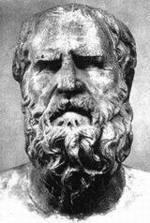
Irakleitos
Heraclitus (~544-483 BC). Born in Ephesus, he was the son of Bloson and hailed from a royal family. Throughout his life, he was an opponent of the masses and the democratic faction. He forced the resignation of Melancomas, an adversary of the oligarchy, and opposed the (failed) Ionian revolt of the democrats against the Persians. Regarding his fellow Ephesians who exiled the best Ephesian, Hermodorus, he stated that they should all hang themselves voluntarily and hand over the city to the minors. The democratic Ephesians decided on Hermodorus's exile on the grounds that there cannot be one better than the others among the Ephesians, and if there is, not in Ephesus and not among the Ephesians! Heraclitus responded that one is more important than 10,000 if he is the best. The best is the one who prefers posthumous fame over fleeting glory.
Heraclitus's philosophical view was contrary to traditional religion and based on aristocratic principles. The subject of his philosophy is not the material principle of this world but the internal rhythm, the Logos, by which the world moves and is regulated. Heraclitus is the philosopher of eternal becoming. This movement of becoming is expressed by the continuous flow of the river, which is constantly renewed. Within the Logos, Heraclitus ties one material element, fire. The existence of fire, along with the Logos, creates a world that is infinite, without beginning, indestructible, self-regulating, and transforms into various forms. This world is the harmony of opposites. The opposites create the unity of everything through their synthesis.
Many of Heraclitus's activities were enigmatic, and his philosophy was difficult to interpret, which is why he was called the "obscure philosopher." When he developed dropsy, he buried himself in the manure of a cowshed so that the emitted heat would absorb the fluids from his body. In this condition, he died at the age of 60. Only fragments of his work "On Nature" have survived. When Socrates read Heraclitus's work, he said, "...what I understood is great, but I think what I could not understand is equally great." The most famous of Heraclitus's sayings, "everything flows," was attributed to him by Plato, but it was not found in any of the surviving fragments of his work.


 Philosophy Books