Henry Wadsworth Longfellow
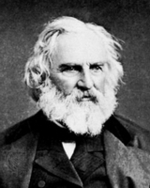
Henry Wadsworth Longfellow
Henry Wadsworth Longfellow was born on February 27, 1807, in Portland, Maine. He started school at the age of just three and showed a strong inclination toward literature from an early age. At thirteen, he wrote his first poem, titled "The of Lovell's Pond," which was published in the local newspaper, the Portland Gazette. While studying at Bowdoin College, Longfellow earned a scholarship to continue his studies by translating Horace. After graduating in 1825, he traveled to Italy, France, and Spain, and in 1829 he returned to America, where he began his career as a professor of modern languages at Bowdoin College. In 1834 he was appointed professor at Harvard University, from which he resigned in 1854 to devote himself entirely to writing. During his career as a professor, his contribution both to students and to America itself was significant, as he fostered interest not only in American tradition and myths, but also in the literature of European countries such as Spain, France, and Italy, as well as in the writings of German, Scandinavian, and Icelandic culture. In 1831 he married Mary Storer Potter and they traveled together to Europe. During his travels, he studied Swedish, Danish, Finnish, Dutch, and literature, and was strongly influenced by German Romanticism. His wife died in Rotterdam in 1835, and three years later he wrote the poem "Footsteps of Angels" in her memory. In 1839 he published his romantic novel "Hyperion" and a poetry collection titled "Voices of the Night," and one year later the book "The Skeleton in Armor" and the play "The Spanish Student" were published. Longfellow was the first American writer to deal with the life and customs of Native Americans in the epic poem "The Song of Hiawatha," which he began writing in June 1854, influenced by the Finnish epic Kalevala, from which he also adopted the meter (trochaic tetrameter). Longfellow also dealt with American history and tradition in two other works, "The Courtship of Miles Standish" (1858) and "Evangeline" (1847), while he visited Europe again in 1842, where he wrote several poems about slavery and published them the same year (Poems of Slavery). In 1843 Longfellow married for a second time, taking Frances Appleton, the daughter of a prominent Boston merchant. But he was unable to find happiness in his second marriage either, as in 1861 his second wife met a tragic death when her dress caught fire from a lit candle. In 1868 he was once again in Europe, where he met the English poet Alfred Tennyson and visited Queen Victoria, who was one of the greatest admirers of his work. In Rome he met the composer Liszt, who set to music the overture from his work "The Golden Legend," which had been published in 1851. Among Longfellow's later works is a trilogy on Christianity, "Christus: A Mystery" (1872), a dance drama titled "The Masque of Pandora" (1873), and the poetry collection "Keramos and Other Poems" (1878). Longfellow's poetry was particularly popular, and he was among the most beloved poets of the 19th century. Longfellow spent the last years of his life in Cambridge, where he died on March 24, 1882. A marble bust of Longfellow has been placed in Westminster Abbey in London, in the Poet's Corner.
 Poetry Books
Dante's The Divine Comedy - Inferno, Purgatorio, Paradiso: Illustrated By Gustave Dore
Dante Alighieri, Henry Wadsworth Longfellow
0