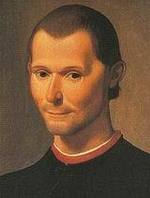
Niccolo Machiavelli
Niccolò Machiavelli (Niccolo di Bernardo dei Machiavelli, May 3, 1469 - June 21, 1527) was an Italian diplomat, political thinker, and writer. He was born into a poor family in Florence, the son of Bernardo Machiavelli and Bartolomea Nelli. His father ensured that the young Niccolò received a humanistic education in line with the classical standards of the time. This education and his connections with Florentine humanists led to his appointment in 1498 as the second chancellor of the Florentine Republic. In this position, Machiavelli was involved in the administration of the regions under Florence's control and was also one of the six secretaries to the first chancellor and a member of the "Ten of War" council, which entailed participation in diplomatic missions. These missions brought him into contact with several of the most powerful political figures of his era in Europe, such as King Louis of France, Pope Julius II, and Emperor Maximilian I of the Holy Roman Empire. Machiavelli was also greatly impressed by Cesare Borgia, who had been appointed Duke of Romagna by his father, Pope Alexander VI. The assessments he made in letters to the Florentine signoria about these figures he encountered as an envoy served as the basis for the portraits he sketched in his work Il Principe ("The Prince").
In 1512, with the help of Ferdinand's Spanish troops, the Medici returned to Florence and overthrew the republic. Machiavelli was dismissed from his position and, a few months later, was tortured and imprisoned for a short period, suspected of involvement in a conspiracy against the Medici. He retired to his family estate in the Sant' Andrea area, where, in the latter half of 1513, he wrote The Prince in a failed attempt to gain the favor of the Medici. In the following years, Machiavelli participated in discussions with a group of humanists who met in the gardens of Cosimo Rucellai and wrote a comedy, "The Mandrake" (1518), and "The Art of War" (1521). Influenced by these discussions, he also wrote the "Discourses" on the first ten books of Livy's History. Shortly after completing the "Discourses," Machiavelli managed to return to Florence, and in 1520 he was commissioned to write the history of Florence. However, the Medici regime was overthrown in May 1527, the republic was restored, and Machiavelli lost his position. Disheartened, he died shortly thereafter in Florence from a stomach ailment.
(Source: Wikipedia, date accessed 11.4.2013)

 Greek Fiction Books
 Greek Fiction Books