Adamantios Korais
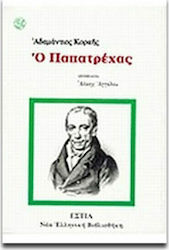
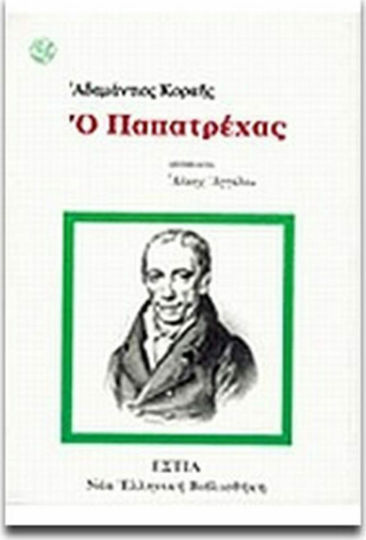
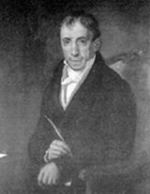
Adamantios Korais (1748-1833). Adamantios Korais was born in Smyrna, and his family hailed from Chios. He grew up in an intellectual environment and graduated from the Evangelical School under the direction of Ierotheos Dendrinos. He focused particularly on learning European languages. In 1772, he left for Amsterdam, ostensibly to work in the businesses of the merchant Stathis Thomas, but in reality, to broaden his intellectual and social horizons. Ten years later, despite initial objections from his family, he managed to leave for Montpellier, France, to study medicine (which he completed in 1787, earning a doctorate). There, he was introduced to the spirit of the French Enlightenment and devoted himself to the study of ancient Greek and Latin literature. The difficult financial situation he faced after the death of his parents a year later forced him to take up translation professionally. From 1788 until the end of his life, he lived in Paris and closely witnessed the French Revolution, the events of which profoundly influenced his thinking. As a member of the Society of the Observers of Man, he engaged in pro-French activities, translating the Declaration of the Rights of Man and other liberal legal and political texts. His interest in the political situation of the new Greek state, although from a distance, accompanied him until his later years, during which he maintained a critical stance against the governance of Kapodistrias. Meanwhile, Korais became a central figure of the Modern Greek Enlightenment, delving deeper into philological and linguistic studies and expanding his network of acquaintances with French and Greek expatriates. In the early 19th century, he gradually developed a theory on the modern Greek language issue, known as the "middle way" theory, which became a point of reference and had various impacts on the subsequent development of the modern Greek language and literature. As a result of a conscious and external intervention in the natural function of the language, Korais' "katharevousa" is fundamentally characterized by its artificial nature, and its role in resolving the long-standing Greek language issue was more obstructive than helpful. In the field of literature, he is placed with his late narrative text "O Papatrechas," a typical example of an attempt at writing with an educational Enlightenment goal. For more biographical details on Adamantios Korais, see Dimitris Kechagioglou, "Adamantios Korais," in "Our Older Prose: From Its Beginnings to the First World War," vol. B' 2, pp. 80-96, Athens: Sokolis, 1999.
(Source: Archive of Greek Authors, EKEBI).