Blaise Pascal
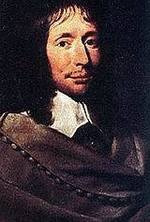
Blaise Pascal
Blaise Pascal was born in 1623 in Clermont-Ferrand to a father who was a judge. He lost his mother in 1626. From a young age, he devoted himself to mathematics, immediately showcasing his genius. In 1647, he moved with his father and sister to Paris, and it is said that between 1652 and 1654, he led a worldly, luxurious, and hedonistic life. However, the winter of 1653-54 was a period of intense scientific work, during which Pascal attempted to solve the problem of the existence or non-existence of God outside the official Christian paths. On the night of November 22-23, 1654, he experienced his famous religious ecstasy, which he recorded on a piece of parchment found sewn into the lining of his coat after his death. In January 1655, at the age of 32, with his health always fragile, he withdrew to isolate himself at the Port-Royal Abbey, where he would return periodically. From 1658, he lived with increasing pain, especially in his head. His activity diminished. In June 1662, he gave his house to a poor family and moved to his sister's. He was seized by convulsions on August 19, 1662, and passed away after receiving the sacraments. Among his major philosophical works are: "Comparison of the Early Christians with the Present Ones," "The Truth of the Christian Religion," the 18 "Provincial Letters," and the "Pensées" (published eight years after his death). In the field of Mathematics, he was a pioneer. His "Essay on Conics" (from which the famous "Pascal's Theorem" derives), his treatise on the "Equilibrium of Liquids" (one of the cornerstones of hydrodynamics), the invention of the calculator (when he was just 20 years old) and the roulette wheel, and his work on "infinitesimal calculus" are only part of his contribution to modern mathematical research.
0