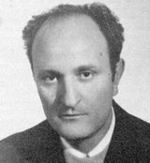
Marios CHakkas
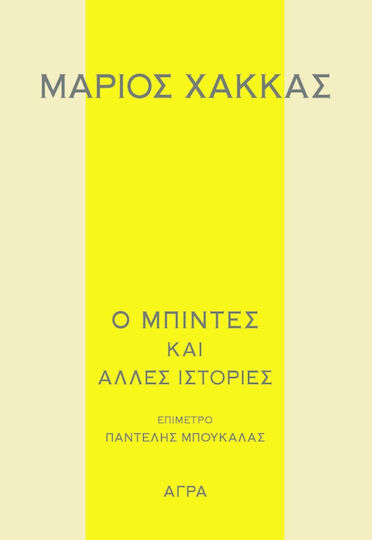
MARIOS HAKKAS (1931-1972). Marios Hakkas was born in Makrakomi, Phthiotis, the son of Georgios Hakkas and Stavroula Karatsali. Four years after his birth, he moved with his family to the refugee neighborhood of Kaisariani. There, Hakkas completed primary school (1937-1943) and then enrolled in the 7th Gymnasium of Pangrati. His school and teenage years were marked by the events of the German occupation and the civil war. In 1950, he graduated from high school and served at the political camp of Gyaros as a student of the Samaritan School of the Red Cross. In 1951, he took exams for employment at OTE (Hellenic Telecommunications Organization), and despite his success, he was not appointed due to his social beliefs. That same year, he began to engage with leftist organizations in Kaisariani and Vyronas and met Marika Kouzinopoulou, whom he married in 1961. In 1952, he became a member of EDA (United Democratic Left), participated in the founding of the first cultural association of Kaisariani (F.E.N.), and enrolled in the political science department of Panteion University. His political activity did not allow him to continue his studies beyond the first two years. In 1954, he was arrested under Law 509 as a member of a leftist organization and sentenced to four years in prison, initially in Kalamata and later in Aegina. In prison, he studied foreign languages and turned to writing poems and short stories. He was released in 1958 and served his military service as a third-class soldier (muleteer). Meanwhile, he continued writing. In 1960, he was discharged from the army and worked in a plastic goods factory, initially as a salesman and later in the store. After his marriage, he moved to Vyronas, while his critical stance towards the Party led to a break in his relations with the Left. From 1964 to 1967, he served as a municipal councilor of Kaisariani and significantly supported the activities of F.E.N. In 1966, his conflict with the Left peaked, and Hakkas turned to a business with frames and miniatures, together with his friend Asimakis Nistikoulis. With the imposition of the April dictatorship, he was arrested and detained for a month at the Pangrati police station. From 1969, his health troubles began, starting with kidney cancer that eventually spread to his lungs. In the last three years of his life, he traveled for medical examinations to London, Paris, Switzerland, Milan, and Germany. In 1970, the theater group "Vimata" of Thanasis Papageorgiou staged his one-act play "Guilt" at the Florida Theater. He died at the Diagnostic Hospital of Piraeus at the age of forty-one. Marios Hakkas belongs to the post-war generation of Greek writers. His first appearance in literature was with "Beautiful Summer," a collection of poems written during the period between his imprisonment and the publication in 1965. Hakkas's poetic language is direct and experiential, moving within the framework of the dramatic writing adopted by many poets of the '30s generation, and expresses the creator's urgent need to escape the inhumane reality he objectively experienced. A year later, he published his first collection of short stories titled "Enemy Rifleman," which belongs to the tradition of post-war realism with a clear ideological orientation and a strong presence of historical and experiential elements. With the collection "The Bidet and Other Stories," a clear shift occurs—a natural consequence of the psychological impact of Hakkas's illness and his break with the communist party—towards a more mature, abstract writing style, influenced by the surrealist movement in its tragic dimension. This style reflects the author's anxiety in the face of death and his disillusionment with the futility of life and ideology in the modern world. His last work, "The Commune," which he did not live to see published, and his three theatrical one-act plays belong to the same period. For more biographical details on Marios Hakkas, see Ziras Alex., "Hakkas Marios," World Biographical Dictionary 9b. Athens, Ekdotiki Athinon, 1988; Kousoulas Loukas, "Marios Hakkas," Post-War Prose: From the War of '40 to the Dictatorship of '67, Vol. H, pp. 86-99. Athens, Sokolis, 1988; and Stavropoulou Eri, "Chronology of Marios Hakkas (1931-1972)," Diavazo 297, 28/10/1992, pp. 22-25, where more information can be found. (Source: Archive of Greek Authors, EKEBI).

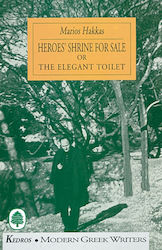
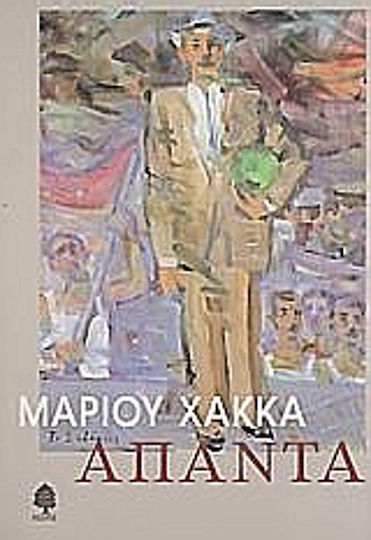
 Non-Greek Fiction Books
 Greek Fiction Books