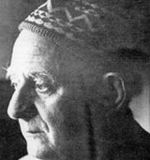
Nikos Kavvadias
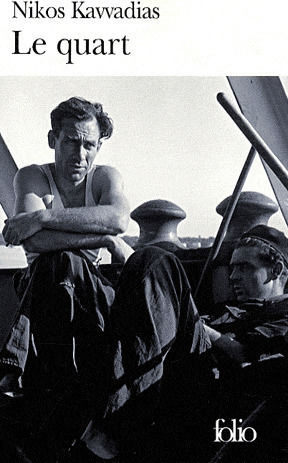
Nikos Kavvadias (1910-1975). Nikos (Kolias) Kavvadias was born in Nikolsk-Ussuriysk, a small provincial town in Harbin, Manchuria, in 1910. He was the son of the merchant Charilaos Kavvadias and Dorothea, née Angelatou, who hailed from Kefalonia. He had an older sister and two younger brothers. In 1914, after the outbreak of World War I, the Kavvadias family visited Greece and settled in Argostoli until 1921, when they moved to Piraeus. This followed his father's return to Russia (until 1921) and his subsequent financial ruin there. In Piraeus, Nikos completed his education at the French school of Saint Paul and high school. Meanwhile, he published his first verses in the magazine of the Great Greek Encyclopedia under the pseudonym Petros Valhalas. He enrolled in the Medical School of Athens, but after his father's death, he was forced to interrupt his studies and work in a shipping office, continuing his collaboration with literary magazines. In 1929, he embarked on the cargo ship Agios Nikolaos, and from 1930 began his period of continuous travels until 1936. In 1932, he serialized "The Incredible Story of Boatswain Nakahamo" in the newspaper Piraikon Vima. In 1933, he published the poetry collection "Marabou," which was enthusiastically received by critics. This was followed by "Pousi" (1947) and the novel "Vardia" (1954), while after his death, the collection "Traverso" (1975) was published. In 1934, his family moved to Athens. In 1938, he enlisted in the army and served in Xanthi. In 1939, he obtained a radiotelegraph operator's license. In 1940, he served in Albania and participated in the National Resistance as a member of the KKE (Communist Party of Greece). From 1945, he was employed as a radiotelegraph operator. In 1953, he obtained the First-Class Wireless Operator's license. His mother passed away in 1965. In 1968, he visited Kefalonia after thirty-five years of absence, where he wrote the prose piece "Li." He died in Athens from a stroke. Nikos Kavvadias is considered part of the Generation of the '30s, although he holds a unique position within it. His poetic expression conveyed the need to escape from the contemporary Greek reality of his time, primarily through elements of cosmopolitanism and exoticism. His writing was mainly experiential and followed an evolutionary path towards abstraction and the limits of surrealism, always within the framework of traditional verse form and rhythmic technique. For more biographical details on Nikos Kavvadias, see Argyriou Alex., "Kavvadias Nikos," World Biographical Dictionary 4. Athens, Ekdotiki Athinon, 1985; Geranis Stelios, "Kavvadias Nikos," Great Encyclopedia of Modern Greek Literature 7. Athens, Haris Patsis, n.d.; and "Gold Dust in Magellan's Beard: Introduction and Anthology by Dimitris Kalokyris," pp. 11-68. Athens, Hermes, 1995. (Source: Archive of Greek Authors, EKEBI).