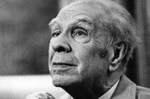
Jorge Luis Borges
Jorge Luis Borges (1899-1986) was born in Buenos Aires, Argentina. He was a descendant of fighters for Argentina's independence, and his father was a lawyer and a professor of psychology at a foreign language school. From a young age, Jorge Luis Borges was bilingual, as his English-speaking grandmother taught him to speak and write in English alongside Spanish. As a child, he expressed to his father his desire to become a writer, and at the age of seven, he composed a summary of Greek mythology in Greek. At eight, he wrote his first short story, and a year later, he translated and published Oscar Wilde's "The Happy Prince." Due to an eye condition that would progressively lead to complete blindness, the Borges family moved to Geneva, where Jorge Luis began his high school studies and received a high-level education, perfecting his knowledge of English, French, and German. He discovered expressionist poetry, German philosophy, and refined his Latin. In 1919, while residing in Mallorca, Spain, he completed his first poetry collection, "The Red Rhythms," which clearly showed his admiration for the Bolshevik Revolution in Russia. After many temporary stays and travels across Europe, the Borges family returned to Buenos Aires in 1921, where they would remain. Borges then discovered the slums of his birthplace with the compadritos ("tough guys"), writing poems, short stories, essays, and "fantasies," founding various magazines, participating in literary circles, and from 1925, when he published the poetry collection "The Opposite Moon" and the essays "Inquisitions," he made a literary presence with one to two works per year until 1985, when his last poetry collection, "The Conspirators," was published. Borges passed away on June 14, 1986, in Geneva.



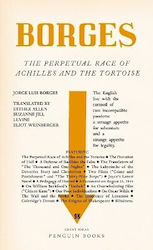



![Άπαντα τα Πεζά [ι]](https://c.scdn.gr/images/sku_main_images/004398/4398858/xlarge_20200219102901_apanta_ta_peza_i.jpeg "Άπαντα τα Πεζά [ι]")
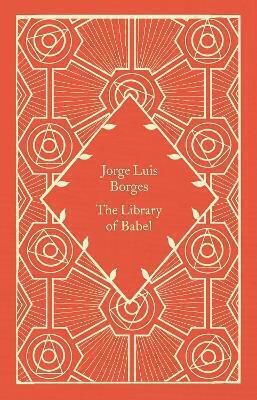 Non-Greek Fiction Books
![Άπαντα τα Πεζά [ιι]](https://b.scdn.gr/images/sku_main_images/004398/4398859/xlarge_20220407071957_apanta_ta_peza_ii.jpeg "Άπαντα τα Πεζά [ιι]")


 Greek Fiction Books
