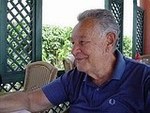
Nikos Kasdaglis
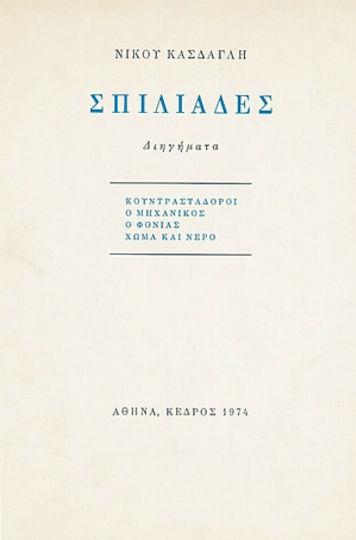
Nikos Kasdaglis was born in Kos in 1928, the son of merchant Christoforos Kasdaglis and Aglaia Venetokleous, originally from Rhodes. After the 1933 earthquake, he moved with his mother and two older siblings to Rhodes, and in 1935 to Athens to attend a Greek school—Greek schools in the Dodecanese had been closed by the Italian authorities. After his father's death in Kos in 1938, the family faced financial difficulties. During the German occupation, he joined right-wing resistance groups and, due to his activities, was expelled in 1943 from the Ionian Academy, where he had been studying since 1935. A year later, he was arrested by ELAS and imprisoned for twenty days. After three years of home schooling and attending only exams, he completed high school. Following the integration of the Dodecanese into Greece, he returned to Kos for a few months and then settled permanently in Rhodes. During the Civil War, the defeat of the Left and the hardships faced by its fighters led Kasdaglis to change his ideological and political orientation, a change completed during his military service (1951-1953). In 1957, he married Rena Athanasiadi. From 1948 until the imposition of the junta of the colonels, he worked at the branch of the Agricultural Bank in Rhodes. The dictatorship dismissed him due to his participation in a condemning declaration by 18 well-known Greek writers against the regime in 1969 (following Seferis's statement on March 29 of the same year—he returned to the Agricultural Bank in 1974). During the seven-year dictatorship, Kasdaglis participated in various resistance efforts (group declarations by prominent figures, publication of the volumes "18 Texts," "New Texts 1," and "New Texts 2," editing the magazine "Synexeia," etc.). In 1969, he was honored by the Ford Foundation for his literary work. He was a member of the Society of Greek Writers until 1981 and a founding member of the Society of Authors in 1982. He collaborated with the newspapers "Kathimerini" and "Ta Nea" and with magazines such as "Epoches," "Tachydromos," "Diagonios" (Thessaloniki), "Poliorkia," "Grammata kai Technes," among others. He made his literary debut in 1952, still a soldier, with the publication of the short story "The Engineer" in Rinos Apostolidis's magazine "Nea Ellinika." This was followed by the publication of the collection of sea stories "Spiliades," and then the novel "The Teeth of the Millstone," which received the second state award, while he established himself in the literary field with the novel "Kekarmenoi." Alongside his prose production, he also engaged in literary translation from French. Nikos Kasdaglis belongs to the Greek prose writers of the so-called first post-war generation. His works are dominated by historical themes, and his writing features naturalistic elements with an emphasis on the depiction of human enslavement and marginalization through social and political mechanisms. He passed away in Rhodes on February 14, 2009, at the age of 81. For more biographical details on Nikos Kasdaglis, see Alexis Ziras "Kasdaglis Nikos" in the "World Biographical Dictionary," vol. 4, Athens, Ekdotiki Athinon, 1985; Lizy Tsirimokou, "Nikos Kasdaglis," in "Post-war Prose; from the War of '40 to the Dictatorship of '67," vol. C, Athens, Sokolis, 1988; I. M. Chatzifotis, "Kasdaglis Nikos," in "Great Encyclopedia of Modern Greek Literature," vol. 8, Athens, Hari Patsi, n.d.; Alexis Ziras "Kasdaglis Nikos" in "Dictionary of Modern Greek Literature," Athens, Patakis Publications, 2007.
(Source: Archive of Greek Writers, EKEBI).
 Greek Fiction Books
 Greek Fiction Books