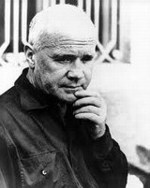
Jean Genet
Jean Genet (1910-1986) was a novelist, playwright, and director. In his early years, he was a thief, outcast, convict, and a homosexual prostitute, but he later became one of the most significant figures of the Theatre of the Absurd, often depicting his own life through his work. Throughout his life, he wandered across Europe, became a darling of the French intellectual scene, devoted himself to an acrobat, and later transformed into a political activist, supporting the Black Panthers and accompanying Palestinian soldiers in camps in Lebanon and Jordan.
The illegitimate son of a prostitute and a laborer, young Jean was abandoned by his parents a few months after his birth but was fortunate to be adopted by a "normal" family, with two peasants as parents. Despite this, he soon exhibited tendencies of marginalization: attempts to run away from home and petty thefts earned him the title of a thief by the age of 12. However, he was an excellent student, which led to his being sent to a technical school outside Paris to learn the trade of a printer. He immediately ran away to pursue his dream of cinema in America. "I decided to renounce a world that had renounced me," he wrote about the turn his life took. Confined in a reformatory from age 15 to 18, young Jean became well acquainted with hard labor, the harsh side of humanity, and homosexual love. He sought to escape and attempted to do so through the military, but he left that too. As a deserter, he changed his surname and wandered across Europe on foot, stealing whatever he could find. But at every stop, he encountered problems with the authorities. Upon reaching Hitler's Germany, he remarked, "I felt like I was in an organized camp of thieves. It's a nation of thieves."
He spent the next seven years in prison. "I see in thieves, traitors, murderers, outcasts, and toughs a profound beauty, an underground beauty." He published his first work at the age of 32, "Our Lady of the Flowers," perhaps the most "incendiary" novel of the 20th century. He wrote it in his cell, on whatever paper he could find. The guards seized it, and he rewrote it from scratch. He gained recognition in Parisian society after meeting Jean Cocteau, who ensured his works were published and helped him out of prison on several occasions. Suddenly, Genet's appearance changed. He strolled through Montmartre and Parisian bistros, dressed as a bourgeois intellectual, in handmade suits and silk ties. He met Jean-Paul Sartre, the person who elevated and influenced him the most. Sartre led a movement among the intellectuals of the time to prevent Genet's death sentence in 1949, and his biography "Saint Genet: Actor and Martyr," published in 1952, not only restored the reputation of a former death row inmate but also elevated him as a leading literary figure and thinker.
After Sartre's portrait, Genet did not write again for seven years. He had learned to be reborn from his ashes, always as something else, something new. This time, he became a playwright who would earn the audience's applause with his "incendiary" performances that respected neither traditional plot nor the laws of psychology. Following cinematic productions and books about Rembrandt and Alberto Giacometti, he wandered throughout Europe. Suddenly, his life changed once again alongside Abdallah Bentaga, a 20-year-old acrobat and his first Muslim lover, to whom he devoted himself entirely. He hired the best trainers, directed his tightrope show himself, convinced him not to enlist in the army, and they began touring together. However, their story did not have a happy ending. After Bentaga suffered a serious injury, Genet abandoned him. Bentaga committed suicide, and Genet fell into deep depression. He destroyed his manuscripts and announced to his friends that he would never write again. He attempted suicide in 1967.
However, he had not yet exhausted all his anger and energy, and for this reason, he could not die just yet. He chose a new life, this time more politically engaged. With violence as his motto once again, he fought alongside the revolutionary organization Black Panthers against racial discrimination and the Vietnam War and for immigrant rights. Next came the Palestinians. Genet decided to live with the Fedayeen in Jordan in 1971, following the conflict between the Jordanian royal forces and the Palestinian organizations that had taken refuge in the country. The material from this visit served as the raw material for his book "Prisoner of Love." However, Genet did not return to settle down and write. Another ten years passed until, in September 1982, he returned to the Palestinians, this time in Beirut. Meanwhile, the Israelis had just invaded the city. He was one of the first observers to visit the Palestinian camp in Shatila, just hours after the Lebanese Phalangists' invasion.
Jean Genet died on a quiet spring morning in 1986, alone in a hotel room in Paris, defeated by cancer. "On a silent and insignificant street, which suddenly shone, marking the last stop of Genet's life in the city, which he transformed and reviled without cease," notes Stephen Barber at the beginning of his biography



 Greek Fiction Books
 Greek Fiction Books