Voltaire
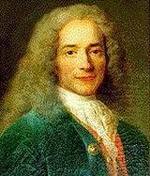
Francois Marie Arouet (1694-1778). He became known by the name Voltaire after publishing "Oedipus," the first of his 27 tragedies, under this pseudonym in 1719. This very pseudonym became a symbol of enlightenment, reason, tolerance, and freedom of thought. Voltaire's life was marked by unpredictable turns. Due to a satire he published, he was imprisoned in the Bastille for 11 months in 1717. In 1719, he became a court writer, but in 1726 he was forced to flee to England.
After his return, he was again threatened with imprisonment, so in 1734 he took refuge in the province of Lorraine. From 1750, he was established at the court of Emperor Frederick of Prussia in Potsdam. After disagreements with the king, he lived in Geneva from 1755 and returned to Paris only in the year of his death. Although he was a skilled writer of plays, historical studies, and also wrote notable poems and witty critiques, his fame is primarily based on the philosophical works he published. At the same time, he was also a philosopher in the traditional sense, as he formulated an autonomous philosophical system.
The goals Voltaire fought for were those of the liberal bourgeoisie, who defended human rights, freedom, and equality before the law, against the arbitrariness of feudal absolutism. He was not an atheist, as is often claimed, since he himself wrote that "nothing is created from nothing" and that "there is a God and he must be just." However, he also argued that "it is impossible for an all-wise God to have made laws to break them," thus opposing the miracle narratives of Christianity, superstition, and religious fanaticism, which brought him into conflict with the clergy who exploit these deviations for selfish purposes to this day. Voltaire foresaw, long before Marx, that religion is used to create an "inverted consciousness" of the world, leading him to consider the struggle and critique against the clergy and religious practice as a prerequisite for any social critique.
Voltaire believed, contrary to Machiavelli and Locke, that "human nature is good" and that all people are born good, but are corrupted by the necessities of life. The great philosopher is considered one of the intellectual fathers of the French Revolution.


 Greek Fiction Books