Giannis Ritsos
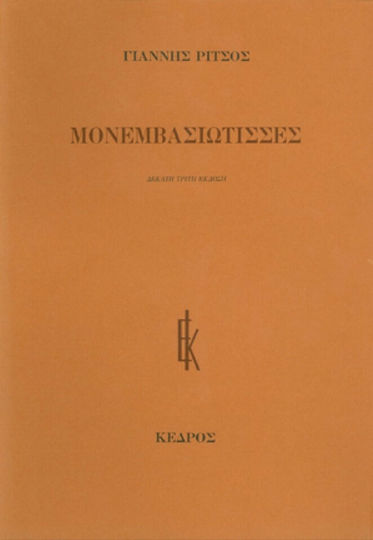
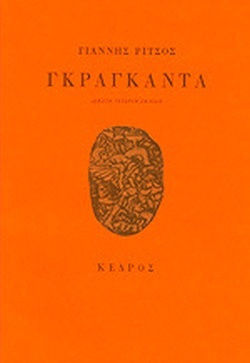
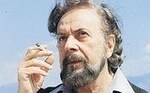
Yiannis Ritsos (1909-1990). Yiannis Ritsos was born in Monemvasia, Laconia, the son of the landowner Eleftherios Ritsos and Eleftheria, née Vouziounara. He had three siblings. In 1919, he graduated from the School of Monemvasia and in 1921 enrolled in the Gymnasium of Gythio. That same year, his brother Manolis and his mother passed away. In 1924, he published his first poems in "Diaplasi ton Paidon" under the pseudonym Ideal Vision. In 1925, he completed his high school studies in Gythio and moved to Athens with his sister Loula. Following the financial ruin of his father, Ritsos worked in Athens, initially as a typist and later as a copyist at the National Bank. In 1926, he fell ill with tuberculosis and returned to Monemvasia until the autumn of the same year, when he enrolled in the Law School of Athens, although he was never able to attend. He worked as an assistant librarian and clerk at the Athens Bar Association. In January 1927, he was hospitalized at the Papadimitriou Clinic and shortly thereafter entered the Sotiria Sanatorium, where he stayed for three years. At Sotiria, Ritsos met Maria Polydouri and Marxists and intellectuals of his time, while also writing some of his poems that were published in the literary supplement of the Great Encyclopedia. From the autumn of 1930, he lived in Chania for a year, initially at the Kapsalona Tuberculosis Asylum, and after personally reporting the appalling living conditions there in a local newspaper, he was transferred with all the inmates to the Agios Ioannis Sanatorium. In October 1931, he returned to Athens and took over the artistic department of the Workers' Club, where he directed and participated in performances. His health gradually improved, as did his financial situation with the help of his sister Loula, who had meanwhile married and moved to America. The following year, his father was admitted to the Psychiatric Hospital in Dafni (where he died in 1938); five years later, Loula followed him but was released in 1939. In 1933, he collaborated with the Left magazine Pioneers and worked in commercial theater for four years (with the troupes of Zozo Dalmas, Ritsiardis, and Makedos). He also appeared in journalism in the columns of "Rizospastis"—where he published his first poetry collection "Tractor" under the pseudonym I. Sostir—and "Free Letters" (1945). In 1934, he was hired as an editor for the Govostis publishing house and joined the Communist Party of Greece. In 1937, he was hospitalized at the Parnitha Sanatorium. The following year, he was hired at the Royal Theater and in 1940 at the Lyric Stage. During the Greco-German War and the occupation, Ritsos was bedridden, yet he participated in the activities of the educational department of the National Liberation Front (EAM) and refused to accept money from a fundraiser when his life was endangered by hardships. During the December events, he frequently visited Kaisariani, met with Aris Velouchiotis, and collaborated with the People's Theater of Macedonia. In 1948, he was exiled due to his leftist activities to Kontopouli in Lemnos, the following year to Makronisos, and in 1950-1951 to Ai Stratis. In 1952, he returned to Athens and became politically active in the United Democratic Left (EDA). In 1954, he married pediatrician Filitsa Georgiadou from Samos, with whom he had a daughter, Eri. In 1956, he traveled to the Soviet Union as part of a delegation of intellectuals and journalists, and in 1959 he visited Romania. In 1962, he visited Romania again, where he met with Nazim Hikmet, and then traveled to the Czech Republic and Slovakia, where he completed the Anthology of Czech and Slovak Poets, as well as Hungary and the German Democratic Republic. In 1964, he participated in the parliamentary elections with EDA. After the Papadopoulos coup in 1967, he was exiled again, this time to Gyaros and Leros, and in 1968 to Samos, where he was placed under house arrest at his wife's home for health reasons. In 1970, he returned to Athens, but after refusing to compromise with the Papadopoulos regime, he was exiled again to Samos until the end of the year when he underwent surgery at the General Clinic of Athens. In 1973, he participated in the events of the Polytechnic. After the fall of the dictatorship and the restoration of democracy, he lived mainly in Athens and was honored for his work by Greece and other countries around the world. Notably, Yannis Ritsos was awarded the Grand International Poetry Prize of the Knokk-le-Zoute Biennale in Belgium (1972), the Dimitrov International Prize in Sofia (1975), the Grand French Poetry Prize Alfred de Vigny, the Lenin Prize (1977), the International Prize of the World Peace Council (1979), the United Nations International Peace Poet Award, the Golden Medal of the Municipality of Athens (1987), the Grigoris Lambrakis Peace Medal (1989), the Grand Star of the Friendship of Peoples (GDR), and the Joliot-Curie Medal (1990). In 1986, he was nominated for the Nobel Prize. He was a member of the Society of Greek Writers (1937) and the Academy of Literature and Sciences of Mainz, FRG, and was declared an honorary doctor of the Universities of Thessaloniki (1975), Birmingham (1978), Karl Marx University of Leipzig (1984), and the Faculty of Philosophy of the University of Athens (1987). He passed away in November 1990, and his remains were buried in his birthplace. A fundamental characteristic of Yannis Ritsos' poetry was its commitment to the service of humanism, love, and Greek identity. During his sixty-year intellectual journey, Ritsos quickly transitioned from the realm of interwar neo-romanticism and neo-symbolism to politically committed art in favor of communism, within which he developed a genuine lyrical style and projected his worldview, remaining throughout his life an exceptionally sensitive receiver of the consequences of political and social developments both in Greece and worldwide. For more biographical details on Yannis Ritsos, see Veloudis G., "Ritsos Yannis," in "World Biographical Dictionary," vol. 9a, Athens, Ekdotiki Athinon, 1988, Angeliki Kotti, "Chronology of Yannis Ritsos," magazine "Nea Estia," issue 130, Christmas 1991, no. 1547, pp. 4-9, Thodoris Petropoulos, "Chronology of Yannis Ritsos," magazine "Diavazo," issue 205, 21/12/1988, pp. 34-46, Yannis H. Pappas, "Chronology of Yannis Ritsos," magazine "Eli-trochos," issues 4-5, Winter 1994-1995, pp. 15-31, Angeliki Kotti, "Yannis Ritsos: A Sketch of Biography," Athens, Hellenic Letters, 1997, and Chrysa Prokopaki, Aikaterini Makrynikola & Giorgis Yiatromanolakis, "Yannis Ritsos 1909-1990: One Hundred Years Since His Birth," National Book Center, Athens, 2010.
(Source: Archive of Greek Writers, EKEBI)