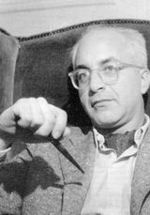
Rodis Roufos
Rhodis Roufos-Kanakaris (1924-1972). Rhodis Roufos was born in Athens, with roots in Patras. He studied at the Law School of the University of Athens during the German occupation, at which time he joined the RAN organization and later took to the mountains of Epirus with the EDES group under General Zervas. From 1949, he worked in the Diplomatic Corps of the Ministry of Foreign Affairs, a position that took him to Vienna, Nicosia (where he was introduced to the circles of EOKA), London, and Paris. In Paris, he stayed from 1960 to 1964 and, alongside his work, prepared a doctoral thesis—which was ultimately not completed—on the Athenian uprising against the Romans in 88-86 BC. After the imposition of the colonels' dictatorship, he provoked his dismissal from the Ministry and engaged in anti-regime activities. He died in Athens at the age of forty-eight from cancer. After the restoration of democracy, he was posthumously honored for his activist efforts with the Grand Cross of the Order of the Phoenix (1975).
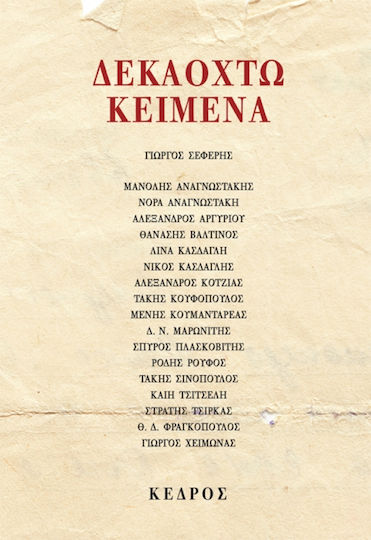
He made his literary debut—under the pseudonym Rhodis Proveleggios—in 1954 with the novel "The Root of the Myth," which became the first part of the trilogy "Chronicle of a Crusade," drawing on the author's experiences in the mountains. The second part, titled "Journey into the Darkness," was awarded the Ouranis Prize in 1956, and two years later, the third part, titled "The Other Shore," was published. Two more novels followed, "The Age of Bronze" (originally published in English under the same title) and "The Graeculi," inspired by his research for his doctoral thesis. Roufos also engaged in translation, essays, short stories, and poetry. During the dictatorship, he anonymously published the denunciation volume "Verite sur la Grece" in Switzerland, which was also released in England in a translation by Richard Clogg. He was also a member of the editorial team for the anti-regime publications "Eighteen Texts" (1970) and "New Texts" (1971). After his death, his wife edited the volume "Selection," featuring his unpublished writings. His works have been published in magazines such as "Nea Estia," "Epoches," "Kypriaka Grammata," and "I Sinechia." The entirety of Rhodis Roufos's work was written over eighteen years and is situated within the realm of post-war Greek literature. The main characteristics of his writing—stemming from his lifelong involvement in the historical developments of his country and the maturity of his political and social reflection—are political contemplation and the consistency of the creator's intentions. Aligned with the Right, he adopted a sober, moderate political philosophy over the years, engaging in self-criticism and envisioning a better world within the framework of universal solidarity and cooperation, beyond party constraints. For more biographical details on Rhodis Roufos, see Alexandros Argyriou, "Rhodis Roufos," in "World Biographical Dictionary," vol. 9a, Athens, Ekdotiki Athinon, 1988; Dimitris Daskalopoulos, "Rhodis Roufos," in "Post-war Prose: From the War of '40 to the Dictatorship of '67," vol. Z, pp. 8-30, Athens, Sokolis, 1988; Alexis Ziras, "Rhodis Roufos" in "Dictionary of Modern Greek Literature," pp. 1950-51, Athens, Patakis, 2007.
(Source: Archive of Greek Authors, EKEBI).


 Greek Fiction Books
 Greek Fiction Books
 Greek Fiction Books