Carlo Goldoni
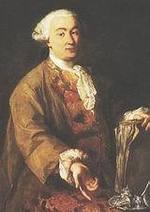
Carlo Goldoni
Carlo Osvaldo Goldoni was born on February 25, 1707, in Venice. He was the son of Giulio and Margherita Goldoni. In his "Memoirs," he mentions that his father was a doctor, but information from that time suggests he was a warehouse manager with relative financial comfort. From a young age, Carlo Goldoni was interested in theater, despite his father's efforts to change his interests. His toys were puppets, and his readings were theatrical works. In 1723, his father sent him to a strict school in Pavia, but instead of focusing on his studies, he read Greek and Latin comedies. Around the same time, he made his literary debut with the satirical poem "The Colossus," which mocked the daughters of Pavia's good families. This caused a scandal, leading to Carlo's expulsion from school, and he left the city in 1725 to move to Udine and enroll in the Law School. He graduated six years later from the University of Modena's Law School. In the meantime, he worked as a judicial clerk for the Venetian Republic. His life changed in 1731 with the death of his father. He decided to dedicate more time to theater. In 1732, a romantic affair and his creditors forced him to leave Venice and move to Milan. There, he wrote the tragedy "Amalasunta," which went unnoticed. He continued in 1734 with "Belisario," which achieved moderate success. In Verona, theatrical impresario Giuseppe Imer guided him towards comedy and introduced him to his future wife, Nicoletta Connio. Goldoni discovered his comedic talent and realized that the improvisational "Commedia dell'Arte," which dominated as a theatrical genre at the time, needed renewal. Inspired by Molière's vivid characters, he wrote and presented his first true comedy, "The Man of the World," in 1738. During his travels across the Italian peninsula, he met comedian and impresario Agostino Medebach, who convinced him to devote himself entirely to theater. Tired of his intense rivalry with playwright Carlo Gozzi, who dominated the theatrical scene at the time, Goldoni left Venice in 1761 and settled in Paris until the end of his life (February 6, 1793). At the court of Louis XVI, he wrote many of his works in French and his famous memoirs with the lengthy title "Memoirs to Serve for the History of My Life and the History of My Theater," from which we draw much information about his life and work. Goldoni's comedies were highly successful in France, and Louis XVI granted him an honorary pension in his old age. The French Revolution cut it off, only for the National Assembly to reinstate it the day after his death, recognizing his value. Carlo Goldoni reformed comedy and turned narrative interest towards the everyday life of his time. From the stereotypical characters of "Commedia dell'Arte" (Harlequin, Pantalone, Doctor, etc.) and masks, he moved to individualized characters and from improvisation to plot and well-rounded characters. His heroes are lively, unpredictable, and entertaining. His female characters are particularly successful, crafted with subtlety and precision, much like Molière did for male characters. However, his works contain greater doses of optimism than those of his great idol. For his innovations, he was criticized by his peers, particularly by Carlo Gozzi, a famous playwright of his time, who remained attached to the conventions of "Commedia dell'Arte." Goldoni continues to entertain theater enthusiasts today, presenting images of themselves, as his plays dramatize the life, values, and conflicts of the middle class. He wrote more than 250 works.
-
Essays
-

All categories

Categories

0