Menelaos Lountemis
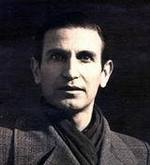
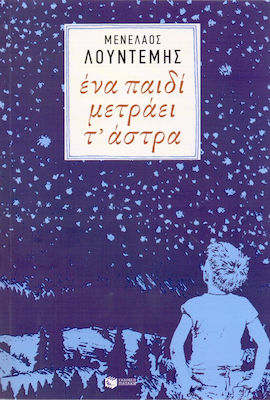
Menelaos Lountemis (1906-1977) was born in Constantinople. His real name was Dimitris Valasiadis, and he came from a wealthy family in the city that went bankrupt after relocating to the Greek state. As a child, he briefly lived in the state boarding school of Edessa, but soon entered the workforce (as a teacher, cantor, and laborer on the technical works of the Gallikos River). He participated in the National Resistance and joined the EAM, where he also served as the secretary of the intellectuals' organization. During the civil war, he was exiled to Makronisos and Ai Stratis, and in 1958 he was tried for his book "Tearful Days." From 1958 until the political changeover in 1974, he lived in self-exile in Romania, and during the Papadopoulos dictatorship, his Greek citizenship was revoked. He died in Athens from a heart attack while driving. He made his literary debut around 1930 with the publication of poems and short stories in the magazine "Nea Estia." In 1938, he published the short story collection "The Ships Didn't Dock," for which he was awarded the Grand State Prize for Prose. He was also honored with the Golden Laurel of Pan-Europe (Paris, 1951). His body of work spans almost all genres of written word (prose, poetry, essay, theater, children's literature, translation, etc.). Menelaos Lountemis belongs to the Greek interwar writers who turned towards social realism. The uniqueness of his work lies in his "amateur" style of writing, which he consciously adhered to, as he claimed he was not interested in Art but in recording reality and highlighting social inequality. Nevertheless, his work is dominated by a tendency to revolve entirely around a central character-narrator (often reminiscent of the author himself), who belongs to the marginalized types of socially oppressed strata and provides a personal perspective on loneliness, unfulfilled love, and the world's misery. His work is heavily influenced by European literature of the socialist realism movement (Knut Hamsun, Maxim Gorky, Panait Istrati, etc.): realistic depiction of landscapes and characters with intense sentimentality that sometimes touches melodrama, experiential writing, ethnographic, and symbolic elements. In works such as "Cloudy" and "A Child Counts the Stars," his psychographic technique is noteworthy, creating complete, vivid characters that form an entire small society, along with his narrative power. For more biographical details on Menelaos Lountemis, see Ziras Alex., "Lountemis Menelaos," World Biographical Dictionary 5. Athens, Ekdotiki Athinon, 1986, and Chatzivasileiou Vangelis, "Menelaos Lountemis," Interwar Prose; From the First to the Second World War (1914-1939) E, pp. 232-252. Athens, Sokolis, 1992.
(Source: Archive of Greek Authors, E.KE.VI.).
 Greek Fiction Books
 Greek Fiction Books
 Greek Fiction Books
 Greek Fiction Books